
Check out that patio.
Geoffrey MorrisonAfter months of planning and building, it was finally time to give my Transit Connect campervan its first big test. Sure, I’d recently done a test run to Pinnacles National Park, but that was only for two nights and I could have left at any time. Due to the obligations of a work project, this first big trip had no such fallback. I’d need to live and work out of the van in a different state for almost a week.
I was optimistic, though, since the test run had gone well. I’d still had a few final things to do before the big trip, however, and less than a week to do them. Not least, I needed to figure out some way to add some heat to the van, since when I’d designed it, I never intended to do much adventuring in the winter. Ironic, then, that my first two trips were in the cold.
Follow my travels on my YouTube channel and check out my book about budget travel, appropriately named Budget Travel for Dummies. Also, check out the previous installments of this series:
- How To Build A Campervan Intro: What’s A Campervan?
- How To Build A Campervan Part 1: The Perfect Van (Also video)
- How To Build A Campervan Part 2: Adding Solar Power! (Also video)
- How To Build A Campervan Part 3: To Seat, Or Not Two Seats (Also video)
- How To Build A Campervan Part 4: Wiring Solar And Batteries (Also video)
- How To Build A Campervan Part 5: Building a Bed and Desk (Also video)
- How To Build A Campervan Part 6: Test Run At Pinnacles (Also video)
Final Touches
While I was optimistic that my secret work location would be slightly warmer than Pinnacles National Park, it was still going to be quite cold at night. I bought a 12 volt space heater, not entirely optimistic it would do much. With just 12V, and a maximum of 15 amps, best case that’s just 180 watts. For comparison, a typical home space heater can be upwards of 1,800 watts. All the 12V space heaters on Amazon have terrible reviews, and I think this is because people are expecting home space heater performance when there just isn’t that kind of power available with a 12V system.
Performance was entirely… whelming. I didn’t expect much and I didn’t get much. That said, it did blow warmer air than ambient, and in the small space of the van and being well bundled under blankets and a sleeping bag, it was adequate. I was certainly warmer than I was in Pinnacles despite the night temps only being slightly higher.
I also purchased an electric blanket, also 12V of course, and that helped a lot too. In fact, if I have another cold weather trip, as long as the temperatures aren’t expected to drop below 40, I might just use that and skip the power-hungry space heater altogether. I talk more about both of these in 11 Best Accessories For Any Campervan Conversion.
Lighting!
Geoffrey MorrisonLighting was the next issue. I didn’t have time to install anything before I left for Pinnacles and let me tell you, it is dark in that van at night. When I returned I installed an LED strip around the panoramic roof using the rubber trim to hold it in place. The result is so good it almost looks like the van came with it, except for the dangling tail and power cable. I’ll figure out how to tuck those in somewhere. In the meantime, the result is a warm light that’s not too bright and pleasantly indirect. I’m going to classify this solution an absolute win.
Dinner and a movie under LED lights. The space heater mentioned above is visible in the center of … [+]
Geoffrey MorrisonThe inflatable mattress I brought to Pinnacles was always intended as a temporary solution. I ordered a layer of “memory foam” from Amazon. It was OK, but not quite enough. Later I found a local craft store that had something even more memory foam-y for less money. Combined, these two layers are about 5-inches total. Not exactly the same as a memory foam mattress, but infinitely better than an air mattress. Overall I’d say it’s quite comfortable. For warmer trips, I probably won’t even use a sleeping bag, and just use sheets like a real bed.
The Adventure
Packed and ready to go!
Geoffrey MorrisonJust as it had been on the drive to Pinnacles, the 6-hour journey from LA to Phoenix was exceptionally pleasant. The Transit Connect is a surprisingly lovely vehicle to drive. Huge panoramic windscreen, comfortable seats, quiet and soft ride, it’s delightful. Yes, my perspective on this is my other car being a Mazda Miata after a long line of hot hatches, so maybe all minivans drive like this, I have no idea.
Cacti
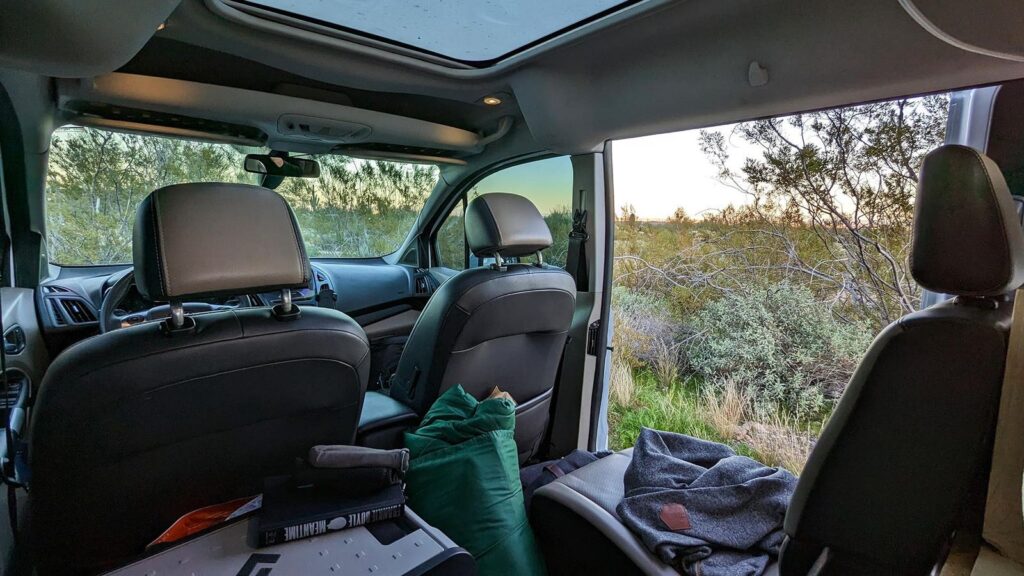
Geoffrey MorrisonWillow Campground, at White Tank Mountain Regional Park, doesn’t have a lot in the way of services, but it does have three incredibly important attributes: hot showers, great views, and close proximity to Phoenix. A 30 minute drive would get me where I needed to go every morning, for $24 a night. Since the cheapest hotels in the area were over $1,000 a night during my visit, this is what thrifty travelers call “a bargain.”
What a view!
Geoffrey MorrisonAfter 5 nights in the van, there are a few things I’m going to tweak before my next big adventure. I need some better organization. There’s a place for everything in “day mode,” but that all disappears once I convert to “night mode.” This might be as simple as some Tupperware containers, we’ll see. I’d also like to figure out a way to get closer to level when parked. Big RVs do this with pneumatic stands, but that’s not an option. Maybe some level indicator like planes have will help me get the best angle when parking, and maybe some shims for the bed to get me the rest of the way. I’ll need to test that out.
The locals were friendly.
Geoffrey MorrisonFor now, though, this was a huge success and just the beginning. Check out the video above for more about the trip and how it went. Next up, a big adventure with a bunch of National Parks. Stay tuned.
If you want to get caught up with the whole process, here’s a playlist that starts from the beginning.
More adventures to come!
Geoffrey Morrison