
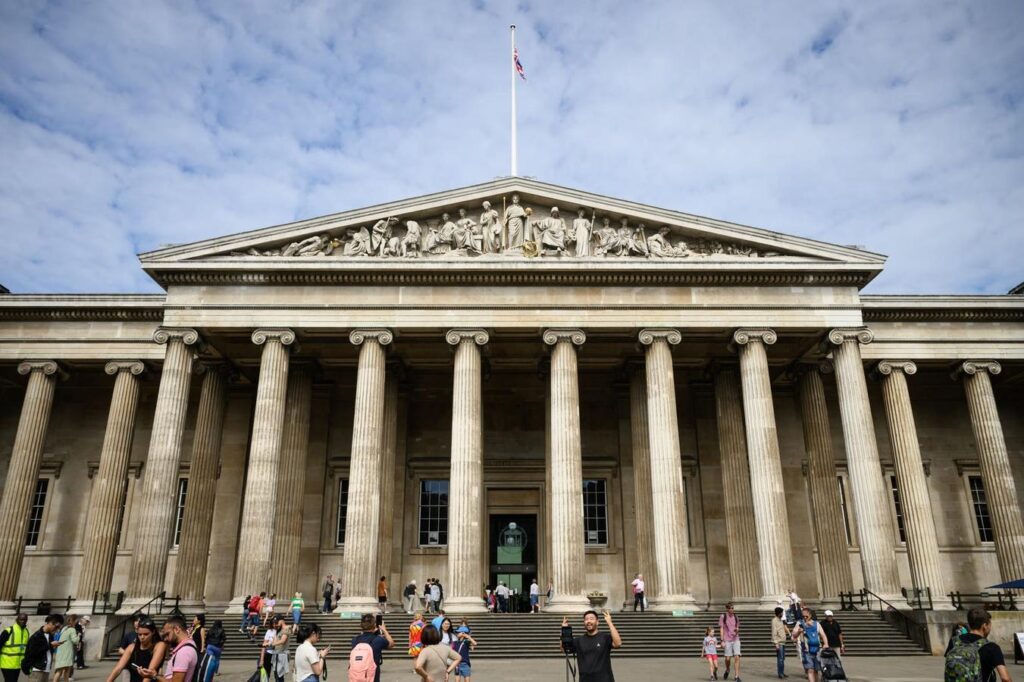
Over 5 million people visit the British Museum each year but there are ways to see it without the crowds (Photo by Leon Neal/Getty Images)
Getty Images
I live in London. Even better, I live near Bloomsbury, a Georgian-era district that surrounds the British Museum, so I’m lucky enough to pop in when I have a free hour or so (like many of Britain’s other major museums, the entrance fee was abolished in 2001). Or, more realistically often decide not to join the queue that would take at least half an hour to navigate. But when I do, I never regret it. This is a world-class collection of the wonderful, the contentious (yes, the Elgin Marbles but also other artefacts) and the utterly jaw-dropping, where a 30-second stroll can take you from Ancient Egypt to Renaissance Italy. With over 8 million objects, for me, part of the appeal of museums like this is that they make me feel as if time – and continents – are shrunk.
The Enlightenment Gallery at the British Museum
The British Museum / Trustees of the British Museum
And to see all this before other visitors arrive? An even more extraordinary privilege. Guests at the Montague on the Gardens hotel, which looks onto the British Museum, can book a private tour. “We’ve always had a relationship with the hotel,” Dirk Crokaert, the hotel’s General Manager. “We’re neighbours.” Good hotels, with centuries of charm to draw on, can charm the impossible, including a precious hour to enjoy the museum before the first visitors arrive.
Gaining special access to museums and historic buildings is something hotels can excel at. It’s an industry where being able to make a well-placed phone call can provide dividends. Well-run hotels increasingly see themselves part of a community and will have been long-term supporters of local institutions, including museums.
A young man on fire duty at the British Museum in World War II
The Trustees of the British Museum
With breakfast in the hotel’s conservatory restaurant, my preview starts with a chat with guide Matt Harrison. Trained as a Blue Badge guide (with a rigorous set of tests to pass), he wants the hotel’s guests to see the British Museum and its treasures through a particular perspective – World War II – in the Conflict and Conservation tour, in the company of 11 other guests of the hotel, for a cost of £950. It’s usually only available if you stay there, but I’ve caught the 91 bus from my home.
Harrison points out that the museum was a target, “but the Third Reich was also aware of its treasures and wanted them to be part of their history.”
Being able to see a major museum before it opens is a rare privilege.
getty
After a short walk from the hotel, we gaze at the museum’s equally imposing facade, created in 1823 by Sir Robert Smirke with an appropriately grand facade. We, however, are heading to the right-hand side where a small doorway leads to the basement and to the British Museum’s backstage. And it feels theatrical – amid the heavy reinforcements that kept most of the British Museum safe. During wartime, some of the museum’s greatest treasures were held here (others were squirrelled away to locations around the U.K.). Now, it looks as if it’s the same – I see signs for Roman helmets and Mummy tins. ‘The Museum shop keeps its supplies here now,’ Matt says, following my gaze.
These were also bomb shelters where staff who lived on site to prevent looting and damage. Photographs from the time show curators on the roof, with the golf clubs they used to propel small incendiary devices away from the building. May 10-11 1941, at the end of the Blitz, was particularly damaging.
The Terrace of the Montague on the Gardens Hotel
Red Carnation Hotels
Then we climb two flights of stairs and emerge – fittingly – into the oldest part of the British Museum, the Enlightenment Gallery – arriving through a secret door that looks like a book cabinet. I’ve been in the gallery several times before and it’s so well disguised that I’ve never realised it. But mostly – in the very oldest part of the British Museum – it’s a chance to see its treasures in silence and exquisite solitude. My footsteps echo on the marble as I go from Egyptian antiquities to the Portland Vase – a stunning cameo vase made around 1C.E. Their beauty – and the giant Buddhas in the Asian galleries emphasise serenity and peace and as the minutes tick down to 10am and the museum opens to the public.