
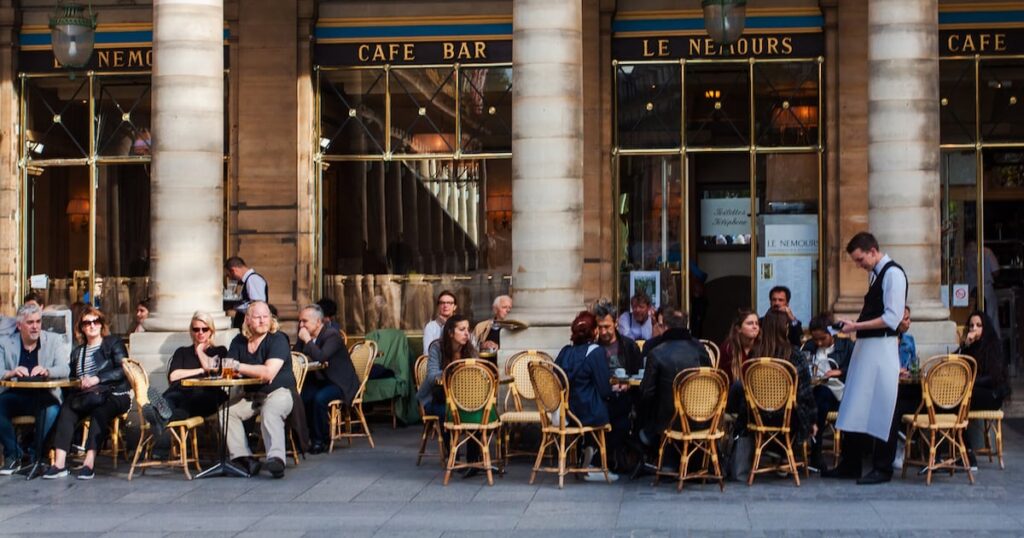
Before you go to Paris, be sure to remember that French food stereotypes persist for practical reasons. Kitchens in this wonderful city are tiny and residents have neither the time nor the inclination to, for example, confit duck – much better to outsource it all to the local neighbourhood bistro. This means duck confit is commonplace in restaurants throughout Paris.
But while it’s easy to find French classics on a menu, how can you work out which menu is best? This is where tricks come in. My top tip is to identify a spot buzzing at lunchtime which has at least one table with an older French woman dining solo, maybe with a small dog or a newspaper for company. These women command a particular power in the social pecking order; they won’t wait in line at the butcher’s shop, preferring to casually skip to the front when they catch the eye of their butcher. As well as this, they certainly won’t tolerate a less than top-notch “menu du jour”, so they are an excellent measure of the quality of a restaurant.
Another tell-tale sign of a good place to eat is seeing small groups of people – usually men, for some reason – dining together. Lunch is sacred in Paris. On a sunny day, people might grab a sandwich to eat in the park, but more usually, it’s a knife-and-fork affair. Employees can avail of a “ticket resto”, a voucher given to them by their work, which can be redeemed in restaurants and supermarkets. This voucher comes with tax incentives and relieves the employer of the obligation to provide a workplace canteen.
On a practical level, it means there is a cohort of people with money to spend in restaurants at lunchtime. To accommodate this, places offer a two-course menu – a starter and main course or main course and dessert – usually for around €25 (you can always add an additional course if you have the appetite or the time). A restaurant filled with small groups (think men reminiscing about their grandmothers’ cooking as they split a dessert)indicates a good local lunch spot. Paris is a city where people tend to eat lunch regularly and tend to eat dinner out more occasionally.
So what else do you need to know?
A staple on every French table is bread and water. Paris is particularly proud of its drinking water, so there is no need to pay for bottled water – simply ask for a “carafe d’eau”. The fountains dotted throughout the city are good to use also. Seventeen of these are charged with CO2 because, be it Champagne or water, Parisians love bubbles in drinks.
It surprises visitors that, except at breakfast, butter is not routinely placed on the table. You can, of course, ask for it, but at lunch and dinner, it’s simply understood that the chef will have made sure the butter is in your meal. There are rules about eating here which can seem tricky to negotiate; I’m still trying to work out why it’s perfectly acceptable to mop my plate with bread but I’m displaying poor manners if I cut the point off a wedge of brie. Ultimately, I know these cultural differences add to the experience.
The French will eat bread up to four times a day. In bakeries, you will hear people ordering their “tradi” as if it were steak, not too well done or well done, depending on preference. And, to ensure it’s at its freshest, you can always ask for half a baguette, which of course will be half-price.
Paris is a low-rise, high-density city, which means locals tend to frequent places in their neighbourhoods. However, thanks to the city’s excellent transport system, I often find myself on the metro seeking out spots to fall in love with or to discover something beyond the expected. With that in mind, here are some places worth noting for your next trip to the City of Lights.
The perfect lunch
JaJa, 3 Rue Sainte-Croix de la Bretonnerie, 75004 Paris, jaja-resto.com/
It’s not often you can see the sky in restaurants in Paris. Tucked away in the Marais, JaJa boasts a glass ceiling. This cosy, light-filled restaurant has a fantastically well-priced lunch menu (two courses for €22, Monday-Friday). The food is thoughtful, seasonal and delicious, with a well-considered organic/low-intervention wine selection by the glass. Dinner is also good here. Booking is necessary.
Contemporary twist on a classic
LuLu Crêperie, Marché des Enfants Rouges, 39 Rue de Bretagne, Paris 75003, instagram.com/lulu.creperie/?hl=en


The Marché des Enfants Rouges bustles with places to eat, but I can never resist the galettes from LuLu; they are extremely generous and use excellent quality ingredients. Cheese is left on the hot griddle to form a lacy crust that keeps me coming back again and again.
A taste of the countryside
La Borie, 9 rue de Pondichéry, Paris, 75015, laborie-ferme-et-restaurant.fr/en-us
La Borie is a farm-to-table restaurant in the 15th arrondissement. Guided by Tanguy Hanoun, all the produce that appears on your plates is sourced directly from the restaurant’s farm in the Haute-Loire. This is an excellent example of seasonal fine dining. The menu changes in accordance with what is available and reflects a commitment to sustainability and a cooking style that lets the ingredients shine.
Modern Lebanese
Madito, 12 Rue de Candie, 75011 Paris, www.madito.fr/en
At Madito, Chef Ahmad El Turk creates dishes using premium ingredients, paying homage to his mother’s home cooking and his heritage. Food is imaginative, modern and full of flavour. The restaurant is warmly lit and food is presented as a tasting menu, which can be adapted for dietary preferences. There is a superb selection of Lebanese wines and a warm, knowledgeable personal welcome.
Asian fusion
The Hood, 80 Rue Jean-Pierre Timbaud, 75011 Paris, www.thehoodparis.com
Chef Pearl Lee is dedicated to showcasing the best pan-Asian fusion cuisine in this casual, friendly spot. The Hood’s take on the classic oeuf mayo is a delight: spicy and unctuous with a bright bite of fresh scallion. The menu is filled with tasty dishes. Make sure you leave room for dessert; the coconut pandan crème kaya toast is a treat. Directly across the road, you will find The Hood’s little sister Nonette – a takeaway sandwich shop that gives a nod to Vietnamese street food and offers a banh mi stuffed with homemade pickles and veggie or meat fillings. Its doughnuts are clever and playful, especially the savoury sweet pork floss mayo or the chilly crisp Chantilly cream.
Late-night bite
Café Louise, 55 Boulevard Saint-Germain 75006 Paris, cafe-louise.fr

It can be hard to find a late-night spot beyond French tacos (which bear no resemblance to the original Mexican staple) or kebabs. Café Louise comes to the rescue, offering French classics in elegant surroundings until 2am. Traditionally, French weddings ended with a hearty bowl of onion soup, served late into the night. It’s charming to find a place keeping this late-night food tradition alive in Paris.
Wine with a view
Le Repaire de Bacchus Printemps de l’homme, 64 Bd Haussmann, 75009 Paris, lerepairedebacchus.com/le-cellier-printemps-haussmann


Hidden on the seventh floor of the men’s building of this famous Parisian department store, you will find a one-of-a-kind Champagne bar and wine shop. There is always a selection of keenly priced Champagnes by the glass and you can pick a bottle (with a €10 corkage fee) to drink on the terrace with panoramic city views. Savvy people time their visits, bubbles in hand, to watch the Eiffel Tower sparkle (nightly, from sunset on the hour for five minutes). Staff are warm, welcoming and exceptionally knowledgeable.
Café culture with an Irish flavour
Early Bird Coffee Marché Beauvau, Place d’Aligre, 75012 Paris, www.earlybirdcoffee.fr


While it’s easy to find an espresso or a café allongé almost anywhere in Paris, finding good coffee in other forms can prove more difficult. Thankfully Dubliner Joseph Loughney has come to the rescue. Having learned his trade in Australia, he noticed a gap in the coffee culture when he moved to Paris and in 2020 opened Early Bird café and coffee roasters, securing a coveted spot in the oldest covered market in continuous use in Paris. The Marché Beauvau, also known as the Marché d’Aligre is after the square where it is located.
Early Bird specialises in carefully selected, ethically-sourced beans roasted on site and supplies some of the city’s most respected restaurants. The store also stocks a carefully curated selection of Irish artisan products, from Harry’s Nut Butters to Folláin Jams and Killahora Apple Ice wine.
Drink like a local
Le Baron Rouge, 1 Rue Théophile Roussel, 75012 Paris, lebaronrouge.net


While in the Marché de Beauvau, stop by this wine spot and rub shoulders with locals. It offers a super selection of wines by the glass, many of which are selected in bulk direct from the producers. You find babies and dogs and plates of wine-friendly cheeses and charcuterie. At the weekend, clientele spill onto the street and baskets of oysters are shucked while chatting with friends. Unpretentious, fun neighbourhood bars like this are rare.
A sweet treat
Diamande, 4 Rue Sedaine, 75011 Paris, www.diamande.fr

This shop’s name is a portmanteau of “diamond” and “almond,” the hero ingredient of these jewel-like pastries. French-born Fayçal Boucherit and Algerian pastry chef Othmane Megnouche showcase Algerian pastries with a focus on high-quality ingredients and a nod to French flavours. Everything is made on site. Order some mint tea and a selection of treats. The orange blossom and cinnamon samsa are magical.
Susan Boyle is a writer and drinks specialist who offers food and drinks tours and experiences in Paris, the Champagne region and beyond.