
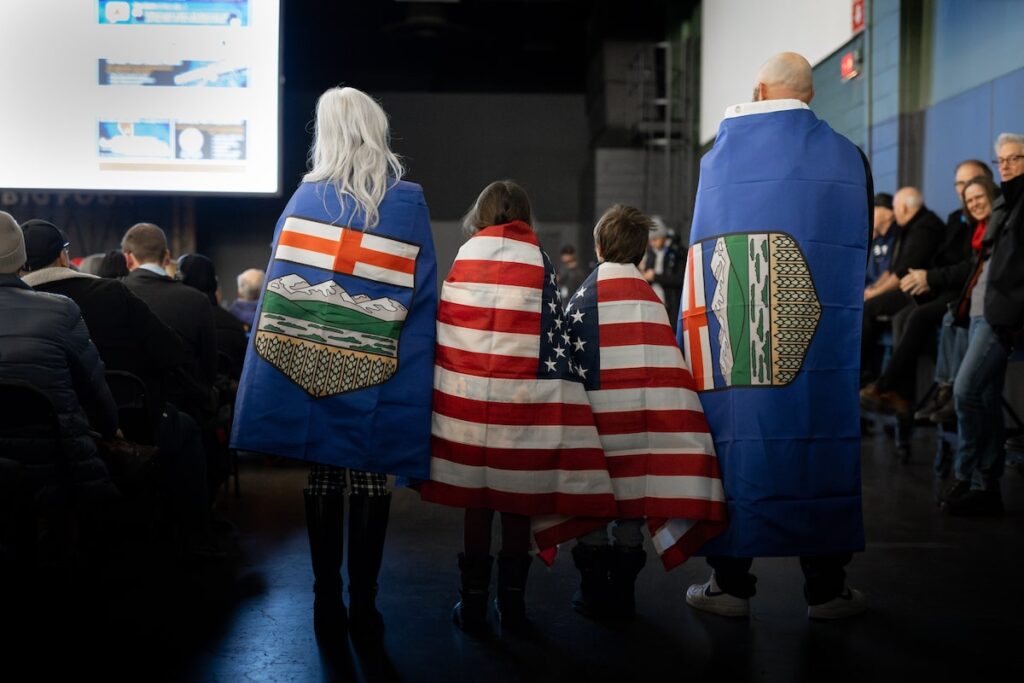
A brief expression of support in Saskatchewan for joining the United States, back in 1980, was stifled by the provincial legislature. Today, some separatists in Alberta have similarly expressed support for union with the United States.Amir Salehi/The Globe and Mail
Bill Waiser is a Saskatoon-based historian and the author of A World We Have Lost: Saskatchewan Before 1905, which won the Governor General’s Literary Award for Non-Fiction.
It’s a sad day for Canada when a provincial premier won’t call out separatists in their province who have been actively soliciting support from the United States. But Alberta Premier Danielle Smith says she doesn’t want to “demonize” anyone for their views.
Saskatchewan‘s historical experience could be instructive for her in showing how to deal with a separatist threat in Western Canada.
On March 11, 1980, former Saskatchewan Progressive Conservative leader Dick Collver rose in the province’s legislature to announce he was leaving the party to launch a new movement to seek a union with the United States.
Coyne: Separatism isn’t treason. Helping Trump take over Canada? That’s another matter
As members sat in stunned silence, Mr. Collver explained that the return of Pierre Trudeau and the Liberals in the February, 1980, general election sentenced Saskatchewan to a dead-end future. The federal government, he believed, would only continue to interfere in the oil and potash industries, to the detriment of the province.
Saskatchewan, then, had three choices: stand by Confederation, seek Western independence or join the United States. That last option, Mr. Collver maintained, was the most ideal for the prairie province – hence the name of his new movement, Unionest, a portmanteau of “union” and “best.”
Mr. Collver justified his cause by claiming that Saskatchewan’s people had more in common with those of the western United States. Central Canada (Ontario and Quebec) might as well have been a foreign country. Nor did Mr. Collver believe that he was an outlier. He claimed that people on both sides of the border shared his sentiment.
“I have decided,” he vowed in the legislature, “to promote and speak out in favour of a union that works, rather than a union that does not.”
The next day, Eiling Kramer, the NDP minister of highways and transportation and one of the more affable but combative members of the legislature, marched into the chamber and draped a Canadian flag over his desk. He then engaged in a staring contest with Mr. Collver, while other members hummed the national anthem.
The tension was ratcheted up the following week when Dennis Ham, the Progressive Conservative member for Swift Current, left his party to join Mr. Collver. The former car dealer said that the Unionest movement meant that “we in Western Canada do not remain colonies of what we know as Canada.” (Mr. Ham was the brother of Lynda Haverstock, the future provincial Liberal Party leader and lieutenant-governor.)
Over the next few days, there was a chorus of calls for Mr. Collver and Mr. Ham – the so-called “Yankee Doodle Dandies” – to resign their seats. Mr. Kramer went one step further, reminding the legislature how traitors were treated in the past. He even placed little Canadian flags on the desks of his NDP caucus members.
Mr. Collver fought back. Eight days after his announcement, he hijacked the budget debate to deliver an indictment of Confederation and how Saskatchewan would be better off as the 51st state.
Amid a wave of Canada-wide unity, Alberta’s separatism movement pushes back
Saskatchewan’s then-premier Allan Blakeney, the Nova Scotia-born Rhodes scholar who led the NDP, gamely responded on behalf of Canada. He readily admitted that Saskatchewan had long-standing and legitimate grievances that remained unresolved, conceding, “I share that impatience.” But Mr. Blakeney would never give up on Canada, never do anything to weaken the bonds of union. “To us the unity of Canada is non-negotiable,” he solemnly affirmed to shouts of support. “The history of Canada is a direct rebuttal to union with the United States.”
A few weeks later, the legislature passed a bill denying party status to Mr. Collver and his sidekick Mr. Ham. Separatism, especially if it meant joining the United States, was not welcome in Saskatchewan. The answer was a resounding never.
Mr. Collver was named Saskatchewan’s newsmaker of the year for 1980, probably because of the theatrical fodder he provided the press. But his Unionest movement collapsed from there. It never contested an election, and after declining to seek re-election in 1982, Mr. Collver turned his back on Saskatchewan. He moved to the United States, where he worked as a funeral director in Sun City, Ariz. It’s not known if he caught the irony. One of Mr. Collver’s first funerals should have been for his Unionest movement.
Today, Alberta separatists who share Mr. Collver’s views should be similarly condemned. It’s not that they are talking about independence; it’s that they are asking for American help. Ms. Smith’s obfuscation on the matter does not help. The separatists represent a looming threat to Canada – and that needs to be said, firmly and loudly.
Editor’s note: Due to an editing error, a previous version of this article incorrectly said that Dick Collver was leader of the Saskatchewan Progressive Conservatives at the time that he launched his Unionest movement. At the time, he was a former leader.
Alberta’s government is clearing more legal hurdles faced by citizens aiming to put referendum questions on a ballot, including questions on the prospect of leaving Confederation. Justice Minister Mickey Amery says new legislation will remove a number of bars a proposed question must meet before petitioners can start collecting signatures, including that questions be factually accurate or even constitutional.
The Canadian Press