
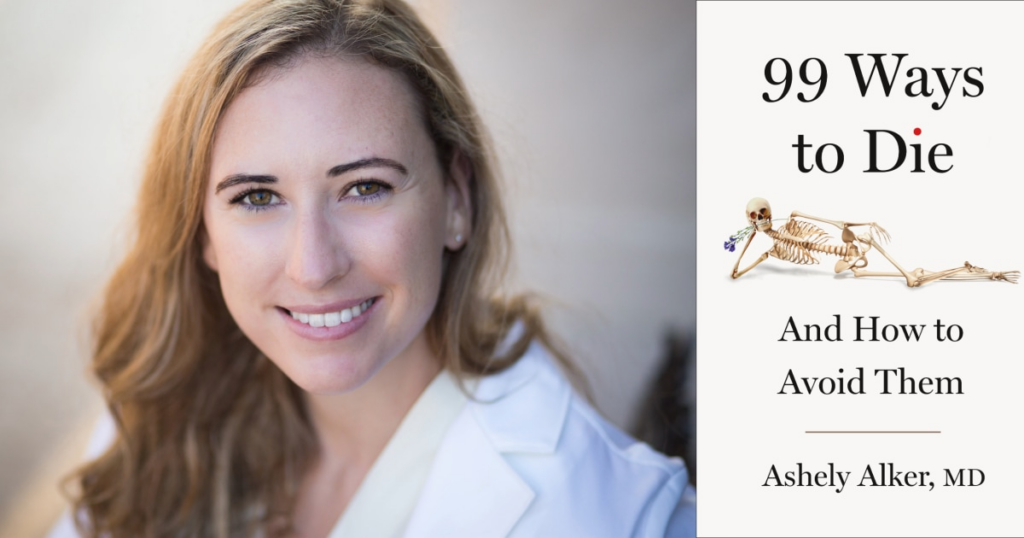
As an emergency medicine physician, Dr. Ashely Alker sees people on the worst day of their lives.
A recent shift included treating a heart attack victim, a patient with severe tongue swelling after being stung by a bee and a woman with something stuck in her vagina.
She’s seen people devastated by infections, heart and brain diseases, drug overdoses, car accidents, animal bites and poisons — the “worst things that ail humanity,” she says.
Alker also commonly removes “rectally inserted objects,” including a TV remote and a papaya. “Butt Stuff” has a section devoted to it in her new book, “99 Ways to Die: And How to Avoid Them.”
She calls herself a “board-certified death escapologist” and says dark humor is almost required in the emergency room.
“Upon agreeing to do this job, you agree to carry certain tragedies with you for the rest of your life,” Alker, who practices in Fredericksburg, Virginia, tells TODAY.com.
“Finding the light there and just using it to prevail as best you can, that’s a superpower in the emergency department.”
She’s a medical consultant and screenwriter, but doesn’t watch medical dramas like “The Pitt” anymore in her free time because she sees the real thing at work.
There are two complaints ER doctors dread when patients come in — dizziness and weakness — because they can either indicate a life-threatening emergency or just benign “symptoms of being alive,” Alker writes in her book.
She shares six common ways to die and how to avoid them:
Strep Throat
“This is one of those things that we just take for granted in our society. We don’t know what strep throat can do. We don’t know that it was deadly and that it used to kill many children,” Alker warns.
“Untreated, it can result in some pretty detrimental health effects.”
They include rheumatic fever, a post-strep disease that destroys heart valves; scarlet fever, a systemic response to strep throat; and toxic shock syndrome, she notes.
Strep throat is a bacterial infection with symptoms that include a sore throat that starts very quickly, pain when swallowing and fever. You can be tested for it at an urgent care or your primary care physician’s office.
The doctor urges people to always get treated for strep throat and finish the full course of antibiotics to prevent deadly complications.
Pregnancy
Alker calls pregnancy “the most dangerous undertaking of their lives” for most women.
“We look at pregnancy as something that women just should do, and it’s no big deal. And that’s just one of my pet peeves,” she says.
“You need to know that when you are becoming pregnant, you’re putting your life on the line for this. That’s fine if it’s your decision.”
The first trimester comes with the possibility of a life-threatening ectopic pregnancy, which happens outside of the uterus, she notes.
The second trimester has risks related to the expectant mom’s immune system changing in order to prevent her body from attacking the fetus. She’s more vulnerable to food poisoning like listeria, which can cause sepsis and stillbirths.
In the third trimester, “all bets are off, honestly, there’s so many things that can happen to you,” Alker warns. That includes heart failure, preeclampsia, blood clots and amniotic fluid embolism, a life-threatening condition where the amniotic fluid gets into the circulatory system.
Alker, who has a 1-year-old daughter, had what was considered a high-risk pregnancy because she was over 35.
“I knew about all of these things before I became pregnant, and I chose to become pregnant and put myself on the line because I wanted to start a family,” she says.
“That’s a decision that every woman should be able to make for herself, because it’s a very dangerous time.”
Tylenol Overdose
Acetaminophen toxicity is the most common cause of acute liver failure in the U.S., according to the National Library of Medicine.
“Tylenol, when taken appropriately, is completely safe,” Alker says. “It’s just people who are taking too much.”
Severe liver damage may occur if a person takes more than 4,000 milligrams of acetaminophen in 24 hours, the maker of Tylenol warns. That amounts to more than eight extra strength caplets during that period.
In the ER, Alker usually sees “purposeful” Tylenol overdoses in the context of young people trying to take their own life and reaching for whatever is in the medicine cabinet. She advises parents that acetaminophen shouldn’t be freely available to kids or teenagers.
Iron Overdose
This is another over-the-counter product that can lead to an overdose and cause liver damage.
Iron, an ingredient in many vitamin supplements, can be harmful in large amounts and is particularly dangerous for children, according to the National Library of Medicine.
“Most people who take iron are taking it in a multivitamin,” Alker says. “For babies, infants, toddlers and kids, if they eat a handful of those, that can be an overdose for them. So anything with iron in it should be locked up.”
Don’t Give Infants Honey or Water
“As a doctor, I feel like this wasn’t something that was really shared until it came up when I had a kid,” Alker notes.
For the first six months of life, babies don’t need hydration other than breast milk or formula, according to the American Academy of Pediatrics.
Infants don’t have kidneys that function properly and can’t filter water adequately, so if you give them straight water, it dilutes their blood and decreases the electrolytes, leading to seizures and other health problems, Alker says.
Meanwhile, honey can contain spores that can cause life-threatening infant botulism, “which is a terrible disease that causes full body paralysis,” she warns. Don’t give honey to children younger than 1 year old, the CDC cautions, since they don’t have the stomach acidity yet to kill the spores.
Botulism
When adults get botulism, it’s often from eating preformed botulism toxin — not the spores — in improperly home-canned, preserved or fermented foods.
Symptoms can start with weakness, and progress to difficulty breathing and muscle paralysis. Botulism requires immediate treatment with an antitoxin to prevent further damage or death.
If you have symptoms, “grab your home-jarred food and go to the closest emergency department” for testing, which could lead to a quicker diagnosis, Alker suggests.
“Botulism is very subtle, especially when it first begins. So it’s a disease that’s really hard to catch,” she says.