
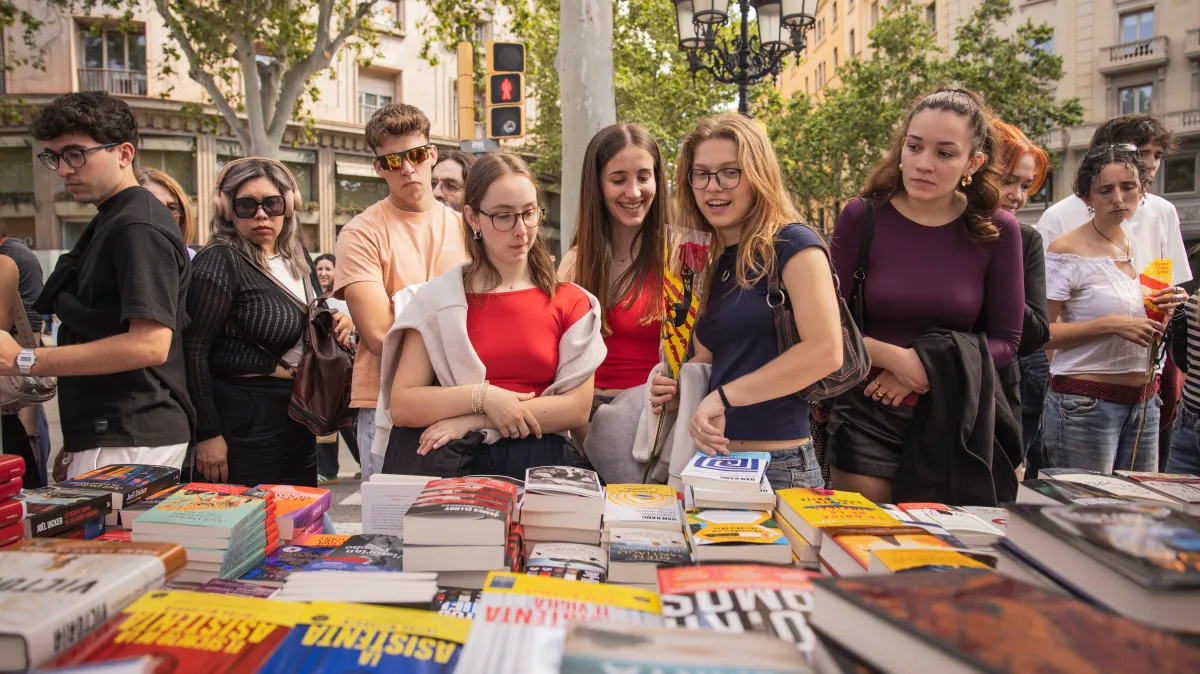
Books are flying off the shelves almost as quickly as they can be restocked. It’s Friday morning at L’Casa del Llibre in Barcelona and, behind the tills, staff frantically giftwrap the latest novels by Isabel Allende, Julia Quinn and Sally Rooney in striped paper.
“This is the most important time of the year for us — more than Christmas,” says Jordi, the manager of the shop on the upmarket Passeig de Gracia. In the next week, L’Casa del Llibre hopes to sell about 200,000 books.
Next Thursday, for World Book Day in Catalonia, shoppers will head to the Passeig de Gracia — the centre of the festival — as the city transforms into one great outdoor bookstore. Roads are closed, hundreds of stalls stretch down the street, authors and illustrators meet readers and people buy roses and books as gifts for loved ones.
This year, booksellers are braced for their biggest ever. Last year there were €26 million in book sales. Of these, 52 per cent were in Catalan and 48 per cent in Spanish. It is a crucial lifeline for the publishing industry, accounting for about 20 per cent of annual book sales in Catalonia alone.

“It’s a working day, but there’s a tacit agreement that after lunch, everyone goes out to buy a book and a rose,” says Xavier Marcé, head of culture at Barcelona council. Last year two million books and seven million roses were sold. “The city has less than two million people and 350 bookstores — that is a huge amount. The publishing industry is thriving here.”
“It’s really unlike anything that I’ve ever experienced in any other city for any other holiday,” says Kate Barasz, founder of The Backstory book shop in Barcelona, who is originally from Boston. “It’s just this day of magic. You walk outside and the street is covered with vendors selling roses. Everyone’s happy and carrying their rose and their book. It’s one of those holidays where it seems like the entire city just participates.”

April 23 is a day of double celebration in Barcelona. It is first and foremost known as Sant Jordi (St George in English). Jordi has been the patron saint of Catalonia since the Middle Ages and the legend of him slaying the dragon has been adapted by both England and Catalonia, leading to different traditions but celebrated on the same day. As the Catalonian version has it, a rose bush grew from the dragon’s blood near the town of Montblanc in Tarragona, and was given by Jordi to a beautiful princess, leading to the tradition of giving roses.


Then, in 1922, the Valencian Vicente Clavel, author and owner of Cervantes publishing house in Barcelona, came up with the idea of a day to boost sales and promote universal access to books. It was originally October 7, the day of the author Miguel de Cervantes’s baptism. After four years of miserable weather, it was moved to April 23 to coincide with the date of his death, on April 22, and the birthday of another literary great — William Shakespeare. The spring weather helped to make it a hit. It took off in Catalonia and is celebrated in Aragon and Valencia, but didn’t really stick in the rest of Spain.
After the success of the Spanish iteration, World Book Day spread globally. It is celebrated on April 23 in India, Sweden, Mexico and about 100 other countries. The UK version started in 1997 and is held on the first Thursday in March to avoid coinciding with half term and the Easter holidays. Spanish parents may have even got a slightly better deal — unlike in the UK, children don’t have to wear fancy dress to school.
There are knock-on economic benefits for the rest of the city, too. Bakeries bake dragon cakes and bread in the colours of the Catalan flag. Schools sell cakes and flowers to raise money and libraries stage free concerts, talks and book signings. This year’s speaker invited to open the festival at City Hall is the Scottish author Ali Smith.
At last year’s festival, the Barcelona Metro recorded its highest number of journeys: 1.87 million trips made in a single day. It surpassed the previous record set the year before.
Children’s and young adult fiction accounted for 31 per cent of sales at Sant Jordi in 2025. In Spain, young people are active readers; about 75 per cent of those aged 14 to 24 read books in their free time, according to the Barometer of Reading and Book Purchasing Habits in Spain.
“We need to show our children, our young people in our lives that reading is something that’s important to us and they need to see us doing it,” says Fiona Hickley, executive director of World Book Day UK. “It sounds like what’s happening in Barcelona is a wonderful example of that.”
The publishing industry in Spain is also helped by the fact that book prices are fixed by the government, meaning they can not be undercut. “No one can change the price of a book, whether it’s e-commerce or a big multinational,” says Marcé. “Small bookstores can be sustainable.”

In recent years, there have been grumbles from Barcelona residents about Sant Jordi. They complain of choked streets and influencers drawn to the photogenic displays on Gaudi’s Casa Mila — which is decorated with red roses — prompting thousands of posts on TikTok and Instagram.
The environmental impact of flying in the seven million roses sold by florists has also prompted a backlash from environmental activists.
When it resumed in 2021 after a pause for the pandemic, the festival was moved from the narrow Rambla de Catalunya to the wider Passeig de Gracia to encourage social distancing.
“It is popular and highly disorganised — until the pandemic came and forced everything to be reorganised,” says Eric del Arco, president of the Guild of Booksellers of Catalonia, which is the closest thing to a co-ordinator for the event, which has no official organiser. “What’s important is that it is a grassroots movement.”
A nominal fee of €100 is paid to the council for one six-metre long table. A shop can occupy a maximum of four tables. Del Arco says that the festival has “reached a balance” and is not actively increasing the number of sellers, which is about 400. There are many unofficial stalls in surrounding neighbourhoods.
Back at L’Casa del Llibre, Jordi says: “There are a lot of people, yes, but for me … it’s still the same as ten years ago or 20 years ago. It’s true that there’s a lot of tourism, but it also seems better-run. It’s crazy, but it’s beautiful.”


He is heartened at the number of young people enthusiastic about reading. “Five years ago, phones were everywhere. But now young people are buying more books. It could be BookTok [the name given to the community on TikTok dedicated to reading], but new things are influencing a new generation. We are selling a lot to young people compared to five years ago.
“For me, it’s fantastic — not as a bookseller, just as a person who loves books.”