
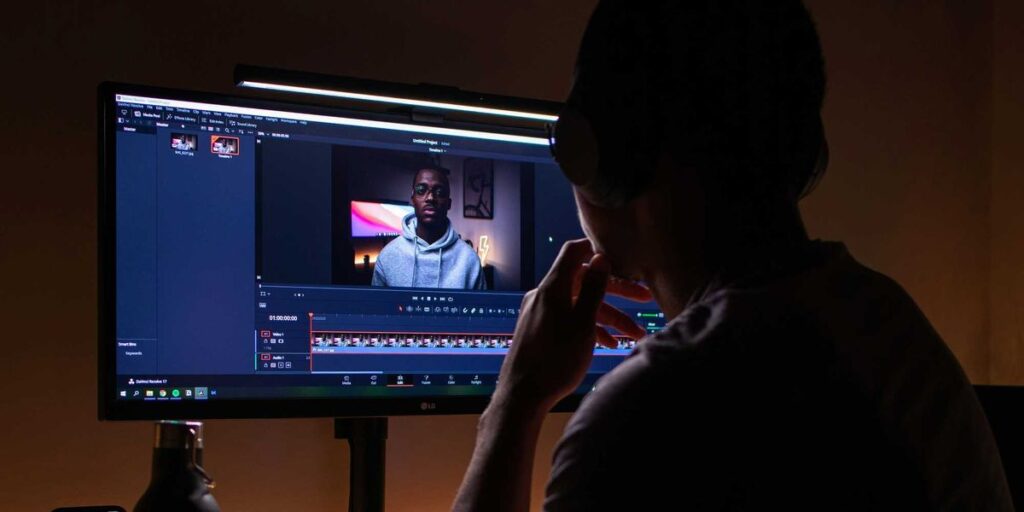
“Cinematic” has become one of those words that gets thrown around so much that it almost loses meaning. But for content creators, it’s a legit goal to set your stuff apart. It might be the difference between footage that stops a scroll and footage that doesn’t.
Desire Lacap of lacapturevisuals, a filmmaker and content creator who makes educational videos about exactly this, recently broke down the layers that make content feel cinematic rather than just filmed (although, for some creators, lo-fi is the goal).
Turns out, the tools are the same ones narrative filmmakers use. But the application is different and useful to understand on its own terms.

Sound Is the Layer Everyone Ignores
I remember early in the days of YouTube when some creators were trying to shoot cooking-style shows out of their home kitchens, and they were standing a significant distance away from their camera. And I remember, even back then, thinking about how these creators needed to invest in some microphones. They were echoing and scratchy, and I could barely hear them. That’s still what I remember about those videos, not actually what was demonstrated or cooked.
Most content creators obsess over the visual side of their work and treat audio as an afterthought. That’s backward. Lacap says, “Sound is what really draws me in subconsciously, without me even knowing it or not.”
The visual side of a piece can get away with a lot, she argues, but when audio is bad, it’s nearly impossible for an audience to stay present with what they’re watching.
For content creators, this means thinking about sound as a layer of production, not a cleanup task in post. Music, dialogue clarity, ambient sound, and effects all stack together to carry emotional weight. Sound design is also one of the most cost-effective ways to raise the perceived quality of your content. Nail your audio, and everything else reads better.
Framing Is About Directing the Eye
As mentioned, there’s a lot of forgiveness on the visual side. It doesn’t have to be perfect, especially if you want something to feel casual and off-the-cuff.
But the rule of thirds is a baseline to get comfortable with. Divide your frame into a 3×3 grid, place your subject along the lines or intersections, and the composition has somewhere for the eye to land.
Lacap adds a practical layer around “look space.” If your subject isn’t looking directly into the camera, give them room in the direction they’re facing. Cutting that space off creates unconscious claustrophobia.
Leading lines are the other foundational tool here. These are natural or built lines in your environment. Is there a doorway, an aisle, tree branches, a road, or something else that pulls the viewer’s eye toward your subject?
Lacap tries to spot these wherever she is, treating the world as a compositional playground. Developing that eye before you pick up a camera is one of the fastest ways to level up your shooting, especially for solo creators who don’t have a DP setting up their frames.
Negative Space Tells an Emotional Story
Negative space is the empty area around your subject. As a storytelling element, it’s an emotional signal, not just an aesthetic one (although it can look great when used intentionally).
For content creators building narrative scenes or two-person scenarios, you should be able to see when negative space communicates character relationships.
“If the characters’ relationships together are more isolated, then I’ll show that in my cinematography,” Lacap says. She typically keeps those characters out of the same frame except in a wide shot.
The audience experiences spatial distance as emotional distance without being told what to feel. That’s the throughline in everything Lacap teaches in this video.
“Make your audience feel something without even realizing what’s making them feel that way,” she says.
Negative space and Mr. Robot-style corner framing are two of the cleanest tools for achieving that subconscious pull.
Camera Angles Are Emotional Arguments
The angels you choose are a statement about the subject’s relationship to power.
Low-angle shots, with the camera below eye level and tilting up, make subjects feel dominant. High angles do the reverse and communicate vulnerability.
Lacap makes a case for the low-angle shot as a character-introduction move. Walk into frame from a low angle, do something, walk out. It establishes presence immediately, without narration.
The Dutch angle (when you tilt the camera off its horizontal axis) creates unease and psychological tension, and Lacap’s warning about it applies doubly to content.
“You want to save these signature shots for when the character or story demands it and avoid using them just for the sake of using them.”
In short-form context, if you’ve gone Dutch twice in a 60-second video, the tool is already tiresome and might have the opposite effect. You either have to be sparing or totally over the top (I’m thinking Boots Riley levels, like how he built a whole set at a 15-degree angle). Either way, be wary of overuse.
Camera Movement (or Stillness) Has Meaning
Every camera movement says something specific, and the difference between intentional movement and restless movement is whether you know what you’re saying.
A push-in signals discovery or emotional revelation. The camera is leaning in. A pull-out creates detachment or the feeling of being lost.
A slow pan builds anticipation. Handheld creates intimacy, chaos, urgency, or the kind of nostalgic rawness that social media audiences have been trained to read as authentic. Anyone can shoot on their phone, messily.
The static shot, which 90% of solo content creators already shoot by default, is a great option, but it’s not always used intentionally.
“Stillness equals tension, right? And when everything in frame is still, even the smallest movement, like a glance or a twitch or like whatever someone in the frame is doing carries weight,” she says.
A locked-off camera isn’t a limitation. Treated deliberately, it can be a setup that makes everything else land harder.
Let us know your other tips for making your content more cinematic.