
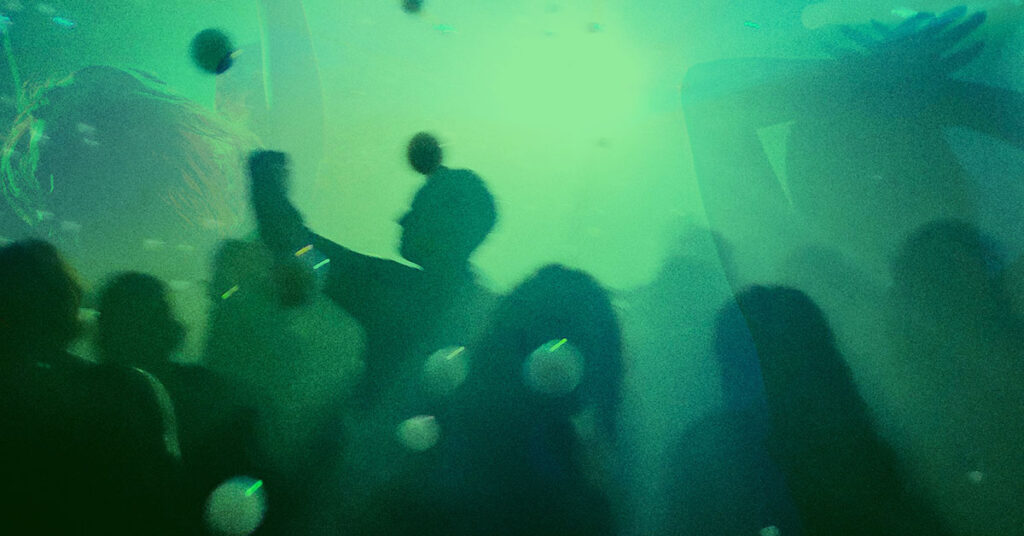
My first thought is that the room—a high-ceilinged loft in a Bushwick warehouse, a section of it draped with sheer fabrics and glowing with blue light—is dark, but not nearly dark enough. I can see the tiny design on the shirt of the person across the circle from me, which means they can clock the same small details on me; I feel exposed, and we haven’t even started dancing.
I am here, as are a dozen other people, to learn how to dance at the club, or Dancefloor 101, as the colorful Instagram flier suggested. According to recent headlines, this is a much-needed endeavor, with young people in particular either unable to let loose or nostalgic for bygone eras of more ferally “getting crunk.” “Suddenly Everyone Is Scared to Dance at Concerts and Clubs,” the Wall Street Journal declared last year, blaming a new fear of “looking goofy” on camera. So when the flyer asked, “want to move but don’t know where to start?” I thought, Yes, feeling sheepish at even acknowledging that impulse. For so many people, dancing comes naturally, but for so much of my life, I have tried to resist the wiggle and the shimmy and the bop, writing dancing off as something not for me.
See, integral to my family lore is the idea that I can’t dance. When rhythm doesn’t evade me, it’s the coordinated motion; even a box step hates to see me coming. “When everyone went left, Bettina went right,” my mom has often said, retelling a story from a school performance when I was child. While I appreciate this as a metaphor for my desire to go my own way or my ability to resist societal pressures, it, coupled with the psychic trauma of awkward middle school dances, has made moving my body to music in public a mortifying act; that I go to so many concerts at which moshing and jumping are the preferred movements is no coincidence. And yet, the body wants what the mind tries to resist: I do, often, feel the music and want to let it move through me. I want to dance in a room with other people, even if it feels embarrassing to acknowledge that, much less do it.
And so, here I am, embarrassing myself. In this loft in Bushwick, I’m trying to see if dancing intuitively is, however unintuitively, something that can be learned. First, the instructor—a dancer and puppeteer who wears neon colors and is described as specializing in “expressive storytelling and tomfoolery”—teaches us about “catching the beat,” as the DJ in the corner gets to work. This, I breathe with a sign of relief, is something I can generally do. The beat, the instructor says, is the collective experience, connecting us to everyone else in the same space. There is a lot of talk of energy: of putting it into spaces through dancing, or of sucking it out by standing still on the dance floor.
We’re to catch the beat in our heads first, and then send it down our bodies, part by part. I can feel it in my head and then kick it to my shoulders and then to my hands and hips. It’s when we’re instructed to connect the beat between body parts that I feel the familiar breakdown, like the glitch if I try to pat my head and rub my stomach. I feel like a robot: unnatural, my body parts too clunky. Can everyone see this? I think, though of course it does not register to me that other people might be thinking the same thing. We then go over how to time our movements to the beat: riding it, versus being “in the pocket” of it. Moving my shoulders and arms, I feel the nuance.
“For so many people, dancing comes naturally, but for so much of my life, I have tried to resist the wiggle and the shimmy and the bop, writing dancing off as something not for me. ”
From here, we build in the question of personal style. In a sense, I wish there was a “right” move. Our instructor calls out animals and shapes and asks us to inhabit those ideas with our movements as we continue to move the beat through our bodies. “Cat” is easy; “triangle” and “shark” less so. But because there is no “right” way to do any of these, I feel myself loosening up, letting myself wiggle and groove, though I still can’t help my tendency to look at someone else and feel the urge to mirror their movements instead of working out my own.
After a short break, our final hour becomes more free-form. We learn how to body roll, a motion our instructor compares to vomiting and then doing the reverse motion; somehow, she says, it ends up looking sexy. It makes my brain short-circuit: If I master one part of the movement, I struggle to do the other, and I catch her seeing me struggle but I’m stuck and go back to easy shoulder motions.
I appreciate the reprieve of discussing dance floor etiquette, practicing subtly asking someone else to dance with us and learning to gracefully sashay through a group of people on a dance floor without killing the vibes. If you’re stuck in a pocket of people who aren’t dancing on a dance floor, you and your friends can turn inwards and make a circle of your own, creating an “incubator of energy” that pulls other people in, our instructor explains.
In the last 20 minutes, the lights dim further, the smoke machine goes on, the music gets louder and we’re encouraged to just dance—no instructions, no exercises, just the collective experience of the beat, however we each choose to interpret it.
I wish I could say that I felt like nobody was watching, or that I suddenly not only snapped into the rhythm but also felt “in the pocket,” or that all my limbs finally, for the first time ever, felt like they were moving in coordinated motion. I did not, but what I did feel was a sense of validation: that I was not alone in my lack of confidence nor in my ability to acknowledge out loud that, despite it all, I wanted to try anyway. It’s so easy to live life thinking our experiences are only our own; it’s nice to remember that other people share our same anxieties and desires.
Will I take these newly earned moves to the club? Well, I’m certainly not ready to body roll anywhere, but I did, at the very least, let a room full of people see me trying.