
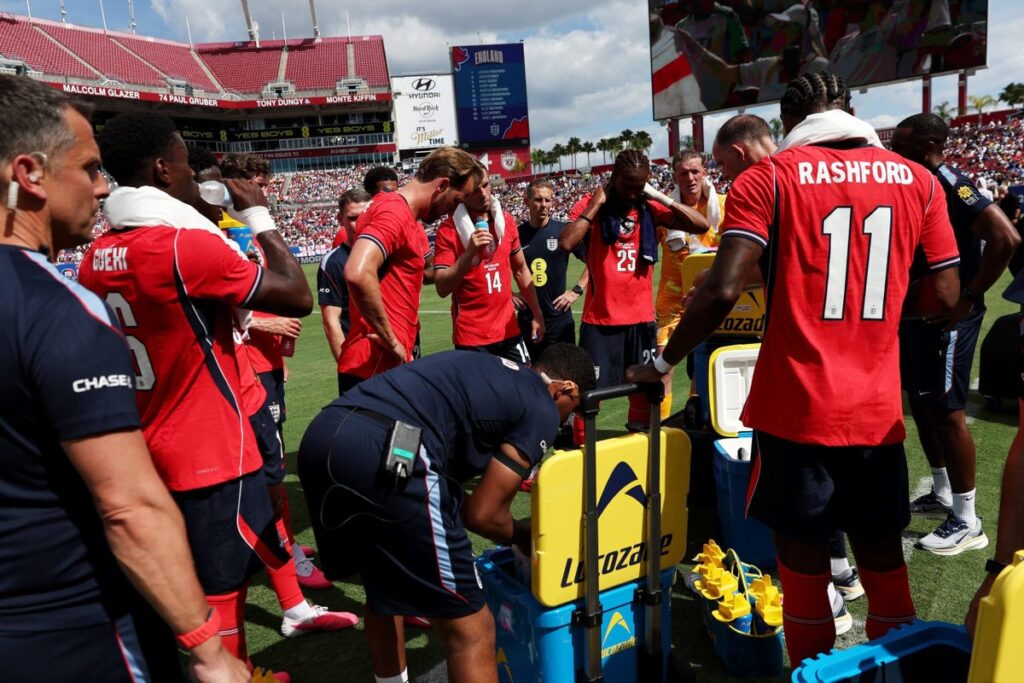
Sweltering, oppressive, stifling.
Call it what you want, this World Cup is going to be hot, with a sizeable chunk of games set to be played above 90F (32C).
It is likely to be the warmest edition since, well, the last time it was held in North America, when the U.S. hosted it in 1994. That World Cup, with more than 80 per cent of matches played before 5pm local time — usually under a baking afternoon sun — became notorious for its draining conditions. A memorable example was Mexico’s 2-1 victory over the Republic of Ireland in Orlando, where temperatures soared to 117F at pitch level.
There is little reason to think this tournament will be much different.
Last summer, FIFA hosted the Club World Cup in the U.S., a competition that served as something of a dry run for the upcoming showpiece. The graphic below, using weather data sourced from Visual Crossing, shows it was warmer than each of the last four World Cups.


But only five of the stadiums used in that tournament are hosting matches at this World Cup, which is also spread across Mexico and Canada. To build a more complete picture, The Athletic analysed 10 years of hourly weather data for each fixture, using the scheduled kick-off time, plus an hour either side, across a seven-day window around the match date.
As an example, for the quarter-final in Kansas City on July 11 at 8pm local time, that meant looking at what the weather was like between 7pm and 9pm from July 8 to July 14 in each of the past 10 years.
The results are shown below, with AT&T Stadium in Dallas topping the temperature charts at an estimated average of 90F (32C), followed closely south of the border by Estadio BBVA in Monterrey. The mercury is expected to peak on July 14, when AT&T Stadium hosts a 2pm semi-final at an estimated 93F (34C). But Dallas is one of three venues, along with Atlanta and Houston, that will operate with closed roofs and air conditioning, making the conditions manageable.


The open-air venues will not be so forgiving. Temperatures have topped 100F at six of the 16 stadiums around kick-off time during the week of the game at least once in the past 10 years. Conditions can feel even more intense at pitch level, according to Aaron Mentkowski, chief meteorologist for WKBW-TV Buffalo.
“That is especially true on days with light winds and full sunshine,” he says. “The fields are mostly open while the stands are shaded. The field absorbs solar radiation from the sun and radiates that heat back onto the pitch. Stadiums tend to protect the field from the wind. A breeze would carry some of that heat away, but instead it just stagnates.”
The Athletic is working with Mentkowski as its resident World Cup weather expert. Throughout the tournament, he will provide daily forecasts and explain the most significant weather events affecting teams and matches in our live coverage.
Extreme heat will hamper performance levels, making it harder to play a high-energy style. “To get a rhythm going under those brutal conditions was really difficult,” said Germany forward Jurgen Klinsmann after his side defeated Bolivia 1-0 in Chicago in 1994.
Some are taking unique measures to prepare.
In North Carolina last Friday, Norway’s players were pictured sprawled out in the sun during training, stripped down to their shorts as temperatures soared to 90F, a far cry from the cooler Nordic conditions they grew up in.
The graphic below shows that those sunbathing Norwegians face one of the biggest increases in temperature during their group-stage matches compared with the average summer conditions where they grew up.


But Mentkowski does not believe players from colder climates will necessarily be at a major disadvantage. “Basically, a fit person from a cool climate will acclimate after a week or two of being in hot conditions,” he says.
Besides, most of Norway’s players are based at clubs outside their home country. The graphic below looks at average summer temperatures weighted by where each country’s squad plays its club football, showing that most teams are made up of players used to broadly similar conditions for much of the year.

While extreme heat and humidity will affect how matches are played, thunderstorms could provide the greater logistical challenge.
Under U.S. thunderstorm protocol, a match must be suspended if lightning or electrical discharge is detected within an eight-mile radius of the stadium. Once that happens, a 30-minute countdown begins, and resets if another strike is detected before it ends. Last summer, Chelsea’s Club World Cup game against Benfica took four hours and 38 minutes to complete after repeated lightning delays.
Mentkowski identifies a number of venues at particular risk.
“Miami and Mexico City will experience daily afternoon storms with frequent lightning and occasional heavy rain,” he says. “Kansas City could experience severe storms depending on how unstable the atmosphere is, as we are still in a severe weather season. Boston, Philadelphia and New York will see heat and humidity increase during the World Cup, with occasional storms.”
These disruptive breaks threaten to stall a side’s momentum, while the uncertainty over when play will resume can test concentration and complicate nutrition and hydration plans.
The ability to adapt to the elements is an underrated factor in World Cup success, and this summer it could prove just as decisive as player quality, team cohesion or tactical schemes.