Horror as a genre lets you get creative at so many levels, including look. Horror cinematography can be colorful and hyper-stylized, or dark and realistic. You can have the neon colors of the original Supiria or its grittier remake, which leans into grimy post-war Germany. Films like The Conjuring and Annabelle have a distinct dark aesthetic. Some are like fever dreams (think Mandy).
To achieve these looks, it’s all about the horror lighting…and, good news, you don’t need an expensive kit or a ton of lights. This style is about committing to darkness, understanding your realistic light sources, and making every light source earn its place.
In a recent video, DP Marco Bagnoli breaks down how a horror-styled IKEA commercial achieved its atmosphere and how you can replicate it. The video covers two setups, but the tips can be applied infinitely.
Embrace Darkness
There’s plenty to be said about darkness and how you use it. Sometimes things are too dark, which was a complaint about some of HBO’s recent shows. But darkness is a tool, and you can use it.
The first move on most sets, especially commercial sets, is to add more light. Bagnoli pushes back, saying if something needs to feel dark and scary, it should be dark and scary. The DP’s job is to create that feeling in the viewer.
He notes that clients often panic when they see a dark monitor, asking for a lamp here, a shaft of moonlight there. Resist that impulse. Overlit “horror” isn’t horror.
We’ve got four ways to light a scene so it feels dark (but actually isn’t). Remember, your darkness has to mean something, though. It’s not about underexposing sloppily.
Wide Shots Are Where Monsters Hide
Horror movies love wide shots because the frame is full of shadowy corners, and corners are where monsters live, or where the killer could be hiding. I can think of several movies that employed this tactic recently, like undertone and Longlegs.
Bagnoli points out that the wide shot creates spatial anxiety. The audience is scanning the room, wondering where danger might emerge.
This compositional choice is as important as the lighting itself, and the two work together. You’re portraying a world that feels unsafe.
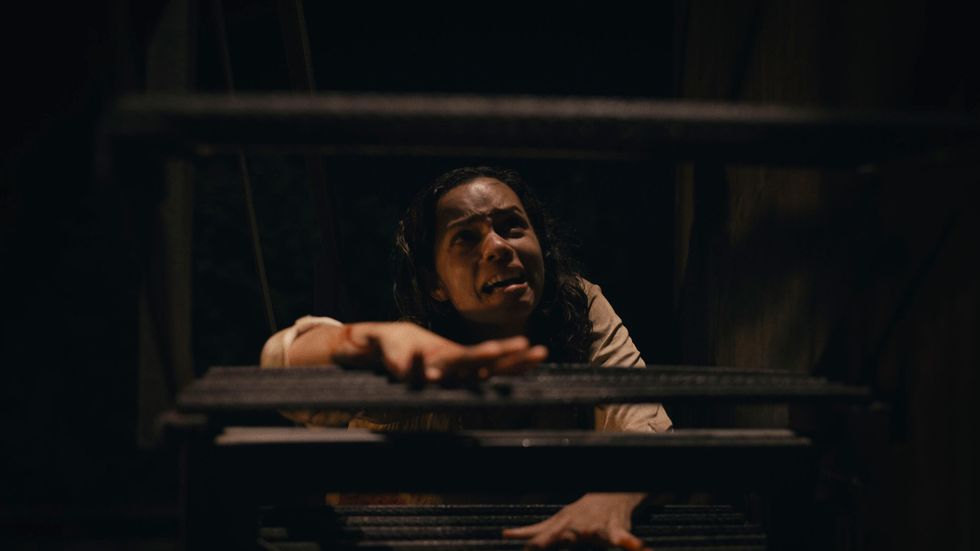 Barbarian Credit: 20th Century Studios
Build Around Practical Light Sources
Once you’ve committed to your framing, the next question is, Where does your light realistically come from?
Bagnoli identifies the three most common options in a domestic interior. You can have practical lamps, a TV, or a light from outside (a street lamp, the moon).
For the night interior in the commercial, the team chose a top light, motivated by a ceiling fixture. It’s a natural choice. Audiences accept ceiling lights as normal. The top light also creates long shadows and concentrates illumination on the subject, letting everything else fall into darkness.
One practical lamp stays in frame to sell the reality.
If you want to create moonlight, we’ve got advice for that, too.
Light the Background, Too
Don’t leave your background pure black, Bagnoli advises. Pure black reads as flat and dull.
In the IKEA spot, a slight blue tint in the curtains was achieved with a simple light source — something like a 600C on a combo stand with a lantern attachment, turned slightly blue and aimed at the curtain.
It gives you separation, depth, and atmosphere without seeming like you tried too hard. I saw the same tip recently in a video where a team was shooting a tablescape from a top-down angle. They put some blue light on the floor to add some depth and texture around the edges of the frame.
The big takeaway is to remember to light more than just your actor. In a big room with a wide shot, if only the subject is lit, the whole thing reads as artificial and controlled. Add something for the background. A hint of light on the wall, the table, the foreground. This makes the frame feel three-dimensional and lived-in, not like a lighting setup.
And if you’re working in a brighter setting, we’ll repeat—let some of the background have shape. It can be light and dark. Don’t blast light all over the background. That will read flat. It’s about layering.
Just look at the lighting in the opening of Halloween as an example. Those shots are almost painterly in how they use light and dark in layers. There’s a ton of dimension.
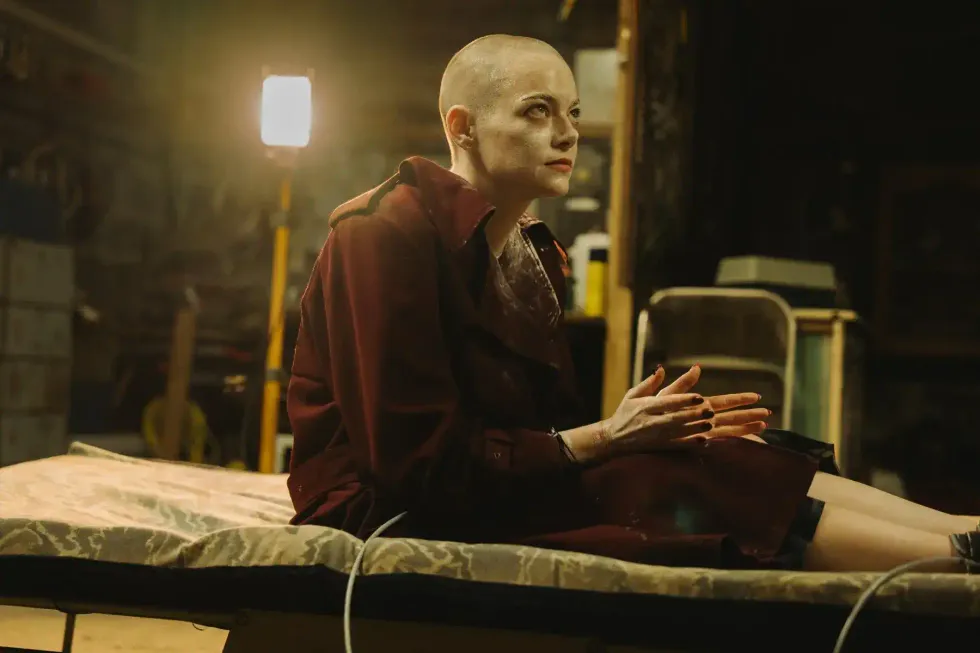 Bugonia Credit: Focus Features
You Can Break Continuity
For the wide shot, the top light made sense. For the closeup, it didn’t.
Top light evens out the face and kills the drama. So the team switched to side lighting for the close-up.
Is that a continuity error? Technically, yes. Does it matter? He says no.
Audiences aren’t watching for lighting continuity. They’re feeling the scene. (It’s like what Deakins said recently, if audiences notice the shot, something is wrong.)
If something looks off, viewers might feel it, but chances are they won’t analyze it. Serve the mood, not the rulebook. Once you stop treating continuity as sacred, you can make each individual shot as strong as possible.
“There are no rules. Most of the time, make the image as beautiful or the most fitting for the scene as possible,” Bagnoli says.
The Daylight Horror Shot
Bagnoli also breaks down a daytime scene in the same location.
The approach flips. Now you’re working with natural light from windows and need to contain and control it rather than build from nothing.
His tip is to expose for the outside so the exterior looks good, then use black fabric (duvetyne) on the walls to stop bounce light and keep the interior dark. Bounce light is your enemy when you want a controlled, moody interior. Without flagging, light will lift your shadows, destroying the contrast you worked to build.
Once everything is flagged, you add your key light from the correct direction, ideally from a distance so it reads as natural, potentially coming through another window. The result is moody and directional.