The monarch butterfly (Danaus plexippus) is one of the most recognizable insects in North America — but it’s not the only orange-and-black butterfly out there. Several species have evolved to look remarkably similar, which can make identification tricky.
This guide will walk you through how to confidently identify monarchs at every life stage, plus how to distinguish them from common lookalikes.
How to identify a butterfly
The first step in figuring out what kind of butterfly you are looking at is asking the right questions! There are certain features that are particularly helpful to tell different species apart. Most are things you can notice from a good photo, but for others you may need to observe the butterfly’s behavior. So, when you meet a new butterfly, ask yourself the following:
How large is the butterfly?
Some butterflies are quite large, while others are positively tiny. Generally, we compare butterfly sizes using their wingspan. Even a rough size comparison can rule out butterflies that would otherwise look alike. You can try mentally comparing the butterfly you are looking at to common species you are more familiar with, such as cabbage whites (Pieris rapae) or tiger swallowtails (subgenus Pterourus). If you can, wait for the butterfly to land and spread its wings so that you get a better sense of its full wingspan.
Monarch butterflies have a wingspan about the size of a playing card, between 3.5-4 inches (9-10 cm), making them relatively large compared to most butterflies. They are much larger than a cabbage white, and of a similar size or slightly smaller than most tiger swallowtails.
What colors and patterns are on the butterfly’s wings?
Wing color is one of the first things you will likely notice about a butterfly! And it can be very helpful in identification, especially if you look at the details of the color pattern. Apart from the overall color, common design elements to look out for include borders around the entire wing, lines (“veins”) that break up the wing into sections, dots or larger circles, or any see-through sections.
Butterflies often have different colors and patterns on the upper side of their wings, visible when they are spread open, and the underside, visible when the wings are closed. Sometimes a clear view of just one side is enough, while in other cases you may need to compare both sides to identify the butterfly.
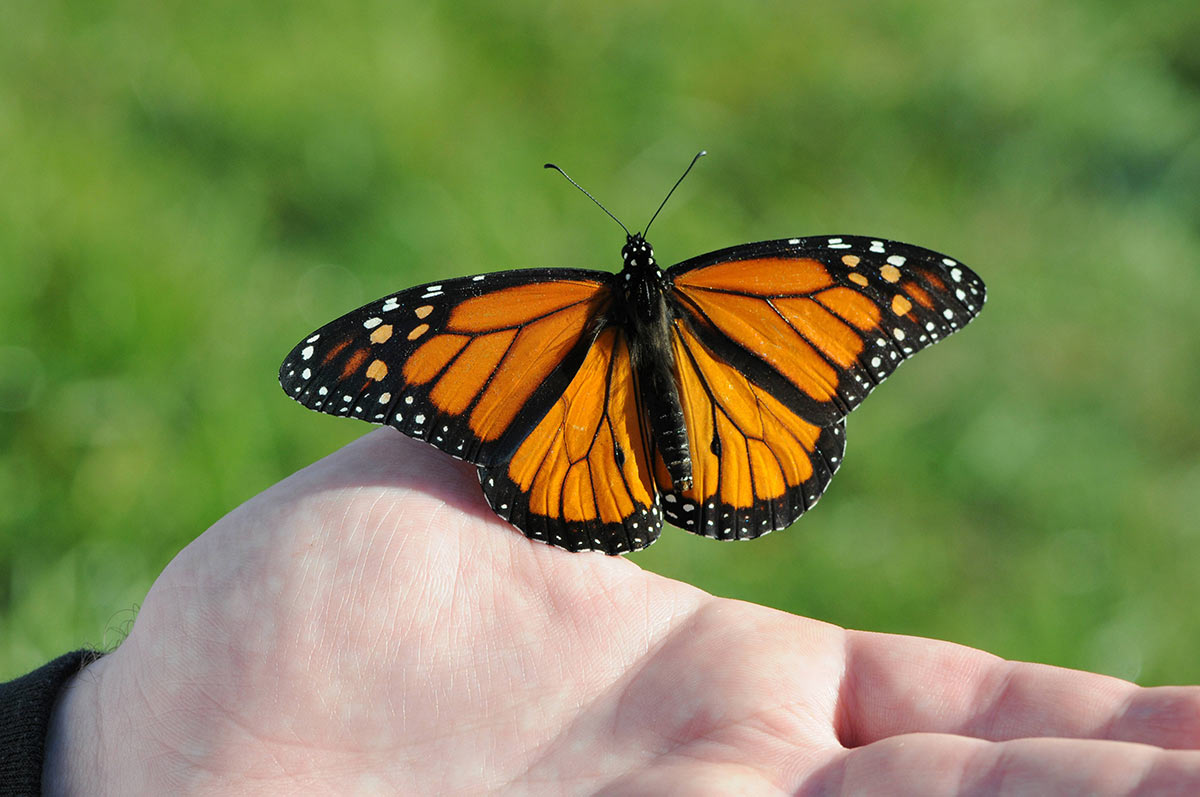
Monarch butterflies have bright orange wings with bold black veins, all surrounded by a thick black border filled with neat rows of small white dots. Importantly, these white dots always fall within the black areas, not orange.
What colors and patterns are on the butterfly’s body?
Getting a good look at a butterfly’s body can be tricky unless it’s holding still, but if you are able to do so, it can provide helpful clues. A butterfly’s body is made up of three parts: the head (with the eyes, mouth, and antennae), the thorax (where the legs and wings are attached), and the abdomen (usually long and cylindrical).
On a monarch butterfly, the head, thorax, and abdomen are black with white markings. The head and thorax are covered in white dots, and the abdomen has white speckles or faint lines.
How is the butterfly flying?
You might be surprised to learn that many butterflies, like birds, have their own signature “style” of flight!
Monarchs have a slow, steady, almost gliding flight. They alternate between flapping their wings and gliding, giving them a graceful, floating appearance compared to faster, more erratic species.
When and where did you see the butterfly?
Different butterfly species live in different places, and they can also be more abundant and active at certain times of the year. You can use tools like iNaturalist to check a butterfly’s range (where it lives) and what times of year it’s most often spotted.
Monarch butterflies can be found across North America and in some other parts of the world. In North America, their range shifts with the seasons: northward across the United States and into Canada during spring and summer, and then southward to overwintering sites in Mexico and coastal California in fall and winter. A few locations with mild winters support monarchs year-round.
How to tell the difference between a male and female monarch butterfly
Male and female monarchs have very similar overall coloration and wing patterns, but there are a few reliable features you can look for. Males have a small black spot on each hindwing (part of a scent gland used during courtship) and thin black veins on their wings. Females lack these spots and have thicker, more prominent, wing veins.

How to identify a monarch egg, caterpillar, and pupae
Monarch caterpillars depend on milkweed (Asclepias) for food, so the eggs and caterpillars are almost always found on these particular plants. Pupae can be attached to a variety of surfaces, including various plants and human-made structures–essentially anywhere that provides a safe, sheltered place to develop.
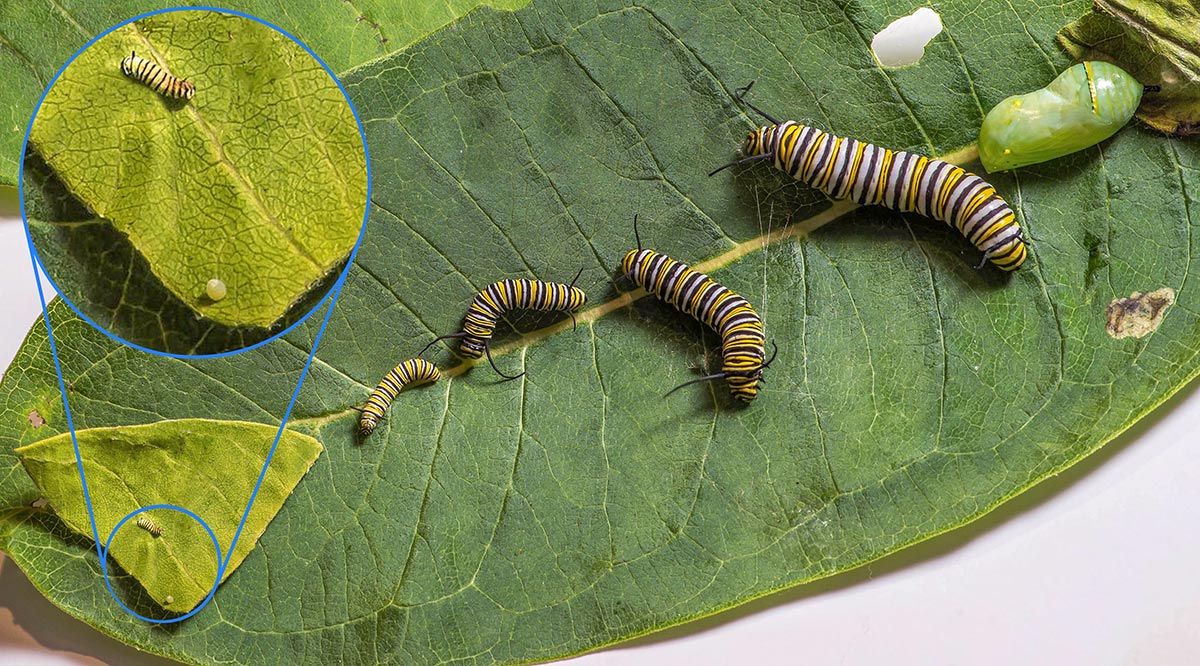
Monarch eggs will be attached to milkweed plants, often on the underside of leaves. They are laid individually, not in clusters, although several eggs may be found close together.
- Size: Approximately 1 mm tall, about the size of a grain of sand.
- Color: Creamy white to pale yellow.
- Shape: Oval or lemon-like, with vertical ridges.
Monarch larvae (caterpillars) grow rapidly, developing distinct features as they mature. These changes include several key characteristics that can be used to identify them.
- Size: Monarch caterpillars go through five instars (growth stages between molts), increasing in size from about 2–6 mm, or a grain of sushi rice, to roughly 4–5 cm, about the length of a matchstick, before pupation.
- Color: As they grow, their bold yellow, black, and white striping becomes apparent and more pronounced.
- Tentacles: Four black “tentacles” (filaments) extend from their bodies: a longer pair near the head and a shorter pair near the rear. They’re barely visible in the first instar, but begin protruding in the second instar. Tentacles are not antennae, though they may look similar.
Monarch pupae (chrysalises) also have several identifiable characteristics.
- Size: Approximately 1-1.75 inches long, and about 0.5 inches wide.
- Color: Pupae begin a jade green with metallic gold dots. They turn transparent before the butterfly emerges, showing the orange and black coloration of adult monarch wings.
- Shape: Like an upside-down tear drop or a pill capsule that’s wider at the top
How to tell monarchs apart from common lookalikes
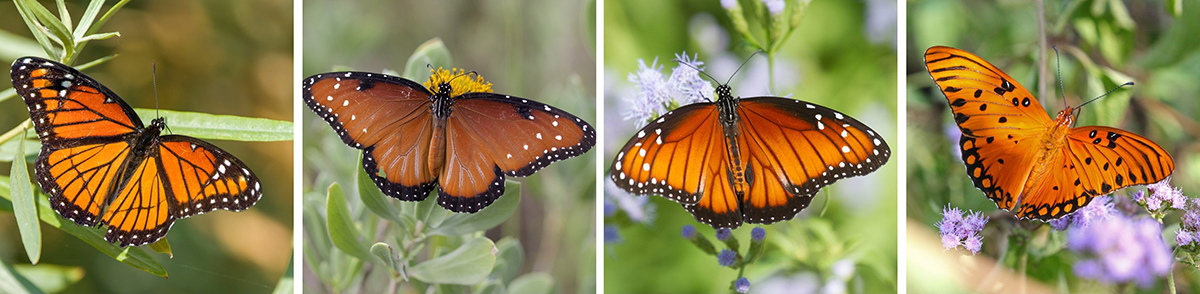
Several butterflies resemble monarchs due to shared coloration and wing patterns. Here’s how to tell them apart:
Viceroy butterfly (Limenitis archippus)
Often mistaken for monarchs, viceroys are slightly smaller and have one key feature that distinguishes them: a black horizontal line crossing the hindwing. They also tend to have a quicker, more fluttery flight. Their coloration can be bright orange and black, similar to monarchs, or darker orange and black like queen and soldier butterflies.
Queen butterfly (Danaus gilippus)
Queens are close relatives of monarchs and share similar coloration. They are slightly smaller in size, and their wings are a more uniform orange-brown color with white spots in both the black and orange areas. They lack the bold black vein pattern seen in monarch wings, and their abdomen is brown or mahogany rather than black.
Soldier butterfly (Danaus eresimus)
Another monarch relative, soldiers are similar to queens in size and color. They have deep reddish-brown wings, minimal black veining, white spots in the orange and black parts of the wing, and a brown or mahogany abdomen.
Gulf fritillary (Dione vanillae)
At a glance, this species can be confused with monarchs due to having large, bright orange wings. However, they are generally smaller and have narrower, more elongated wings. Their bodies are orange and brown with pale-colored stripes. Their wings have black spots rather than the monarch’s black outer border, and when their wings are closed, the undersides have distinctive, shiny silver spots on a brownish-orange base. They are also very fast, erratic, and skittish flyers.
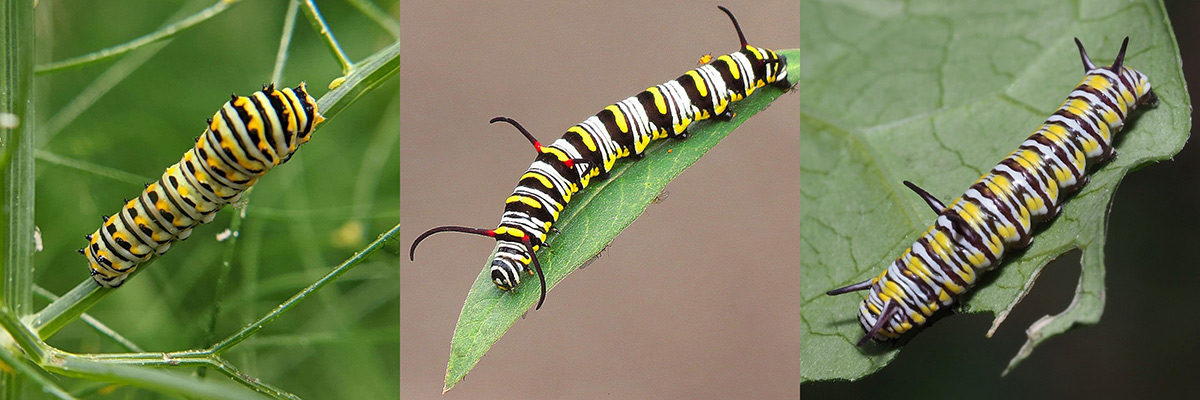
Likewise, several caterpillars can be confused with monarch larvae.
Black swallowtail larvae (Papilio polyxenes)
These caterpillars can sometimes be mistaken for monarchs in later stages. They are light green with black bands and yellow spots, but they lack the monarch’s black tentacles. If found on dill, fennel, parsley, or rue, it is almost certainly a black swallowtail.
Queen larvae (Danaus gilippus)
Very similar to monarch caterpillars, but these have three pairs of tentacles (front, middle, and rear) that are black or reddish in color. Black stripes also surround the yellow along the body. The yellow stripes are sometimes more muted or broken up compared to the distinct, bold bands of the monarch. These larvae will also be found on milkweed.
Soldier larvae (Dione vanillae)
Nearly identical to queen caterpillars, soldier larvae also have three pairs of tentacles (front, middle, and rear) and will be found on milkweed. Their colors often appear more “patchy” or less sharply defined compared to monarchs. And like queens, they can have a more velvety or matte appearance with slightly textured skin.
Why do these butterflies look so similar?
The short answer is that all of these butterflies have evolved to try and communicate the same idea with their colors: “don’t eat me, I’m dangerous to eat!” The use of bright, contrasting colors to ward off predators is called aposematism.
Monarchs are bitter-tasting and toxic to predators because of what they ate as caterpillars. Milkweed has certain chemicals (called cardenolides) in it that most animals can’t eat, and monarch caterpillars store up all of these chemicals and keep them even after becoming butterflies. Birds and other predators that try to eat monarchs quickly learn to avoid that color pattern after a few mistakes. Other butterflies benefit by resembling monarchs, either because they are also toxic or in the hope that predators can’t tell the difference.
Queen and soldier butterflies are close relatives of the monarch butterfly, belonging to the same genus, Danaus. Closely related species often look similar, and in this case, all three share the same warning signal. Like monarchs, queens and soldiers also feed on milkweed plants as larvae, therefore becoming unpalatable — and even harmful — prey.
Viceroys, on the other hand, are not related to monarch butterflies. For a long time, scientists believed that viceroys were perfectly edible and had evolved similar colors to monarchs in order to deceive predators. However, research later discovered that viceroys also taste bad from accumulating toxins, making their orange-and-black colors an honest warning.
Monarchs and their lookalikes need our help
Populations of monarch butterflies have declined significantly in recent decades. While some lookalike species are faring better, many butterflies face similar threats: habitat loss, pesticide use, and climate change. Helping monarchs can also benefit their lookalikes, as well as other invertebrates that desperately need our help!
Here’s how to make a difference:
Learning to distinguish monarchs from their lookalikes deepens your connection to the natural world and makes every sighting more meaningful! With a bit of practice, you’ll not only recognize a monarch at first glance, but also grow your appreciation for the fascinating survival strategies that animals adopt.