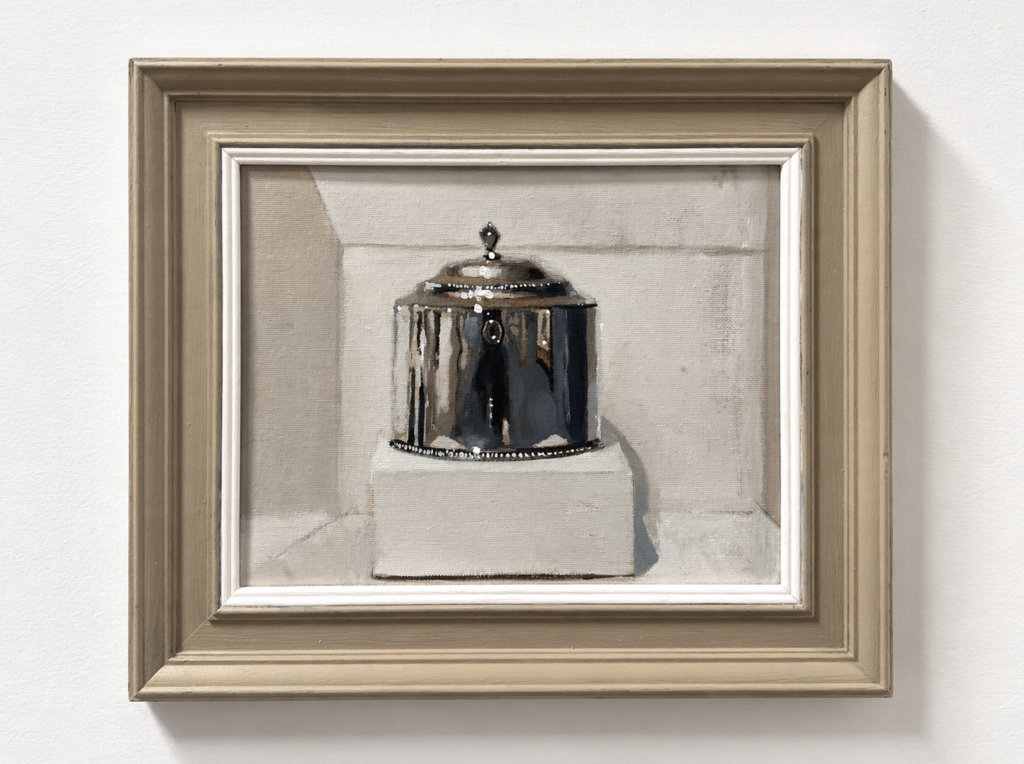
Will Kemp, Tea with Nicholson, Acrylic on Canvas Board, 20 x 25cm
How to Paint Reflective Silver with a Limited Palette
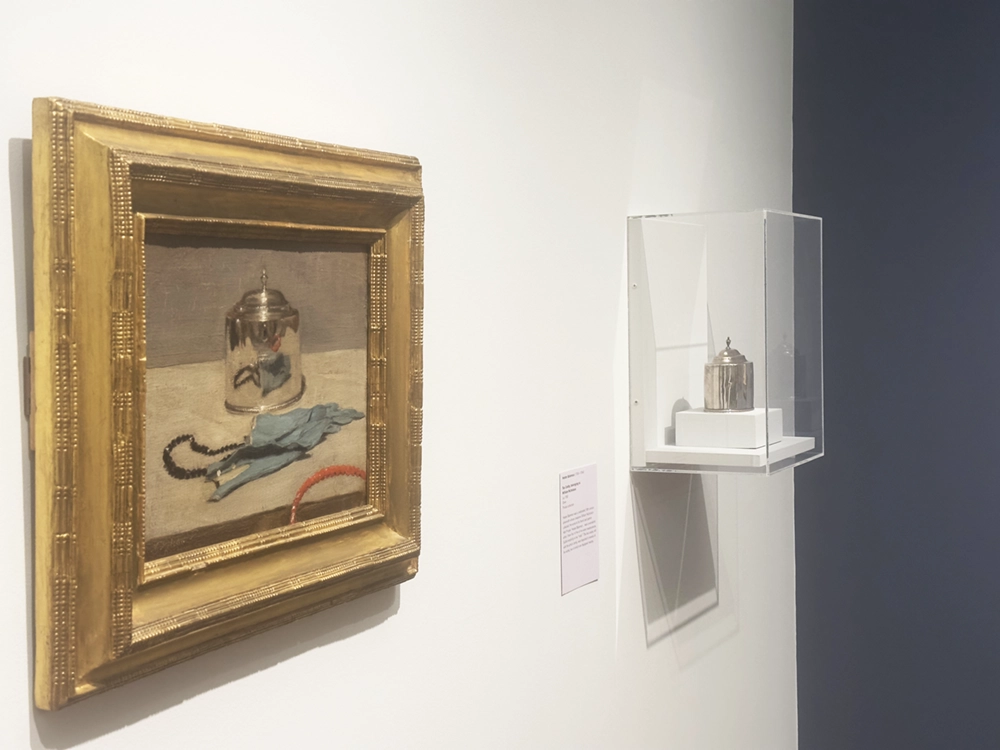
One of the highlights of seeing William Nicholson’s still life paintings at Pallant House last week, was discovering a small display plinth with the actual silver tea caddy he used in a few of his still life paintings.
Download the Reference Image
You can download a larger 20 x 25cm silver caddy reference image here (opens in new tab)
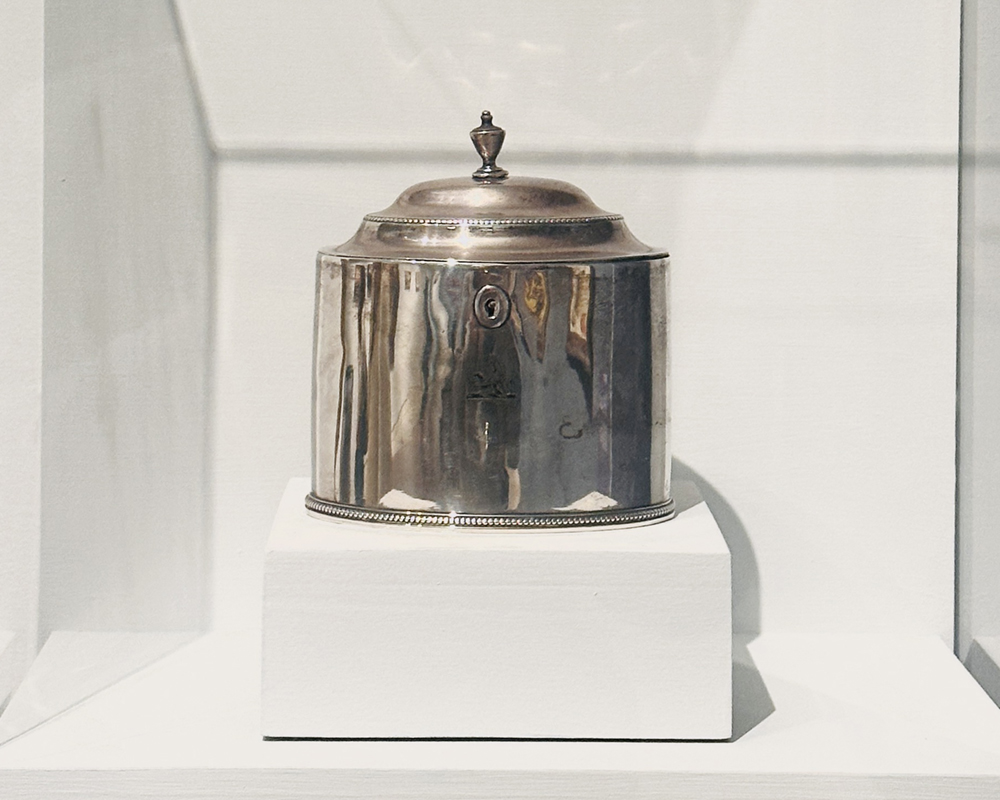
Silver reflections on the Tea caddy, Nicholson used for his still life paintings.
I took a quick snap of it and thought it would make a great little tutorial. It gives us a chance to look at how you can paint reflected light and create the illusion of silver, using a limited palette.
Materials you will need:
Surface: 8 x 10 Inch (20 x 25cm) Canvas Board
Acrylic Paints:
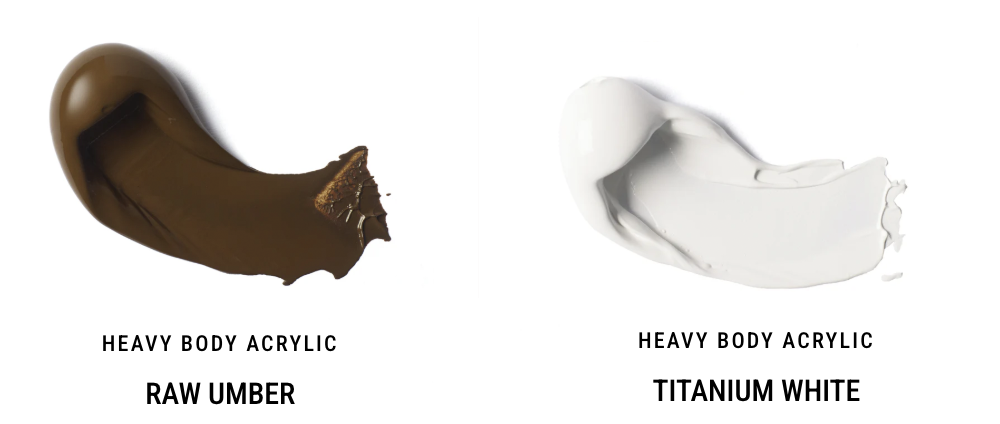
- Raw Umber
- Burnt Umber
- Prussian Blue
- Cadmium Yellow
- Titanium White
Brushes:
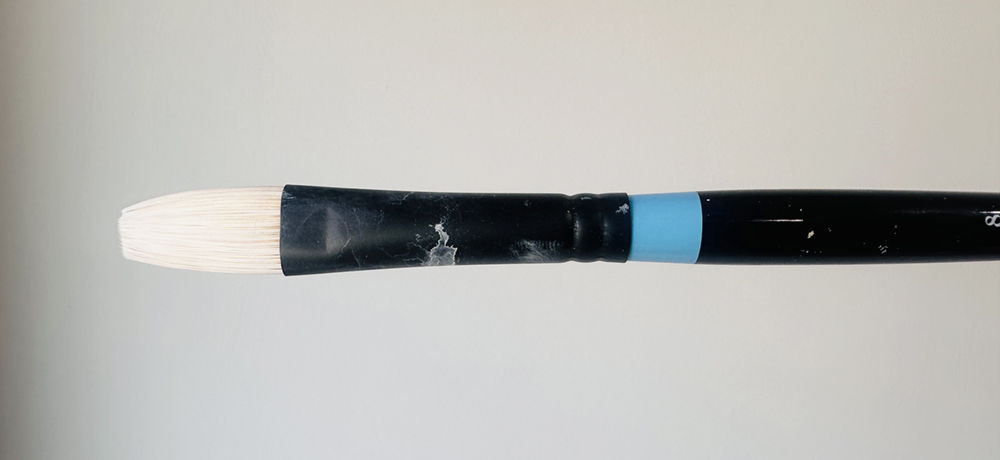
- Princeton Flat, Small round
Mediums:
- GOLDEN Glazing Liquid Gloss, Water
How To Paint Silver Reflections in Acrylics
The subject is a silver tea caddy, but it’s sitting inside a display case, which creates interesting, angled shapes along its sides. I liked those extra shapes in the composition, so I decided to keep a few of them in the drawing rather than just isolating the tea caddy.
Step 1: Prepare a Coloured Ground
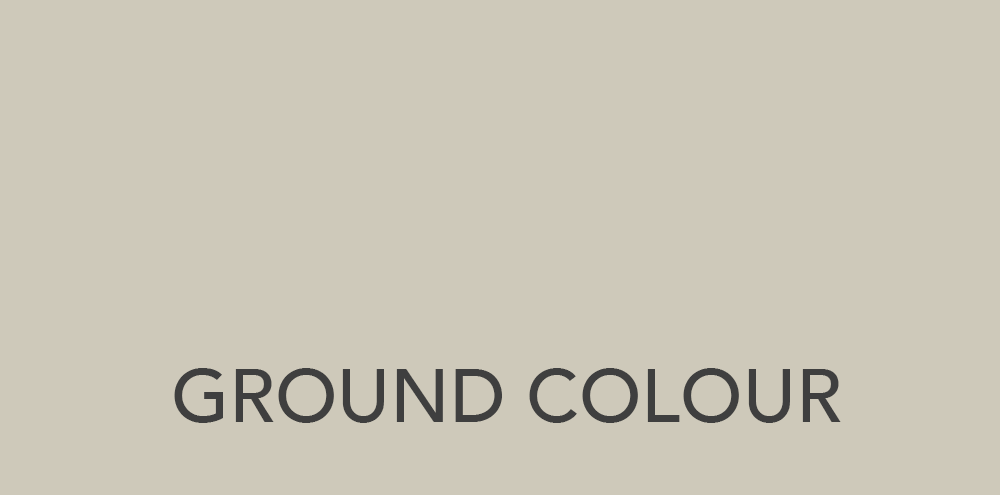
I started with choosing a coloured ground to establish a value (lightness or darkness) that would work with the background shadows. I was trying to match the shadow value on the left of the reference image.
I mix with a palette knife, and add a touch of water to dilute it:
- Titanium White
- Raw Umber
- A small touch of Cadmium Yellow (any yellow would work)
I mixed the colour together, diluted it with water, and painted it quite thinly onto the canvas board. Then I scraped it back slightly so it became more of a stain on the surface rather than a thick layer of paint. This gives you a neutral starting point, which is much easier than painting directly onto a white canvas.
Step 2: Draw Out the Main Shapes
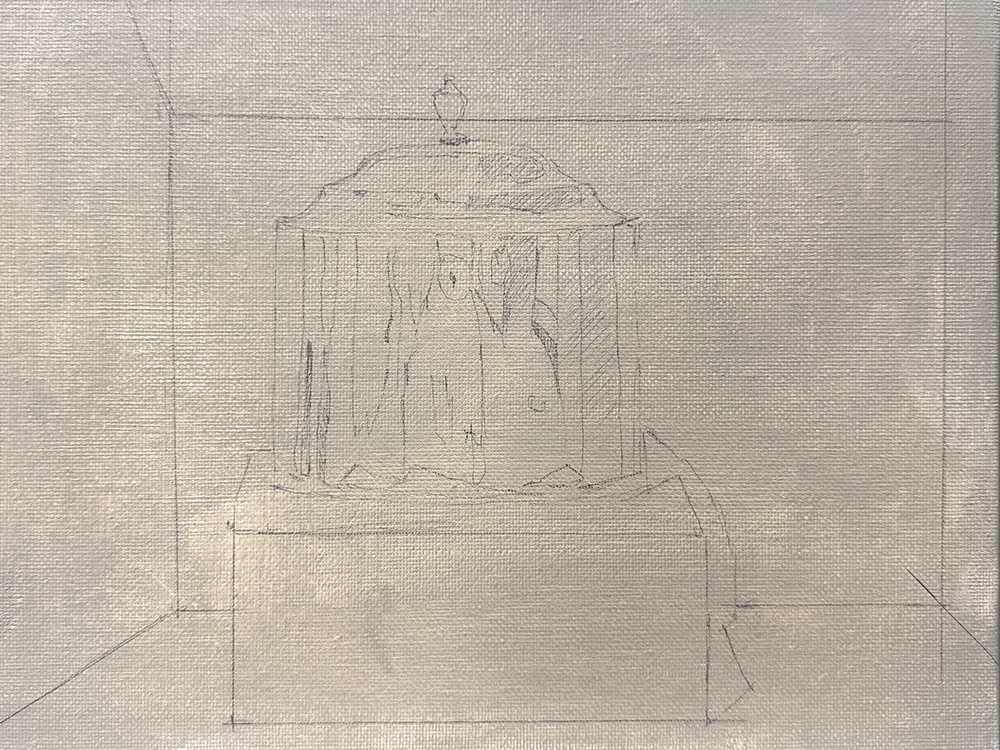
Once the ground was dry, I drew out the main shapes using an HB mechanical pencil. I used a Kuru Toga mechanical pencil, but any HB pencil would be fine.

At this stage, I’m not trying to draw every tiny reflection. I’m just looking for the big shapes:
- The outline of the tea caddy
- The main angles of the display case
- The plinth underneath
- The larger shadow shapes
- The main divisions within the reflections
With reflective silver, it can be tempting to chase every little detail straight away, but it’s much easier if you begin by simplifying the subject into larger abstract shapes.
Step 3: Block in the Darkest Areas with Raw Umber
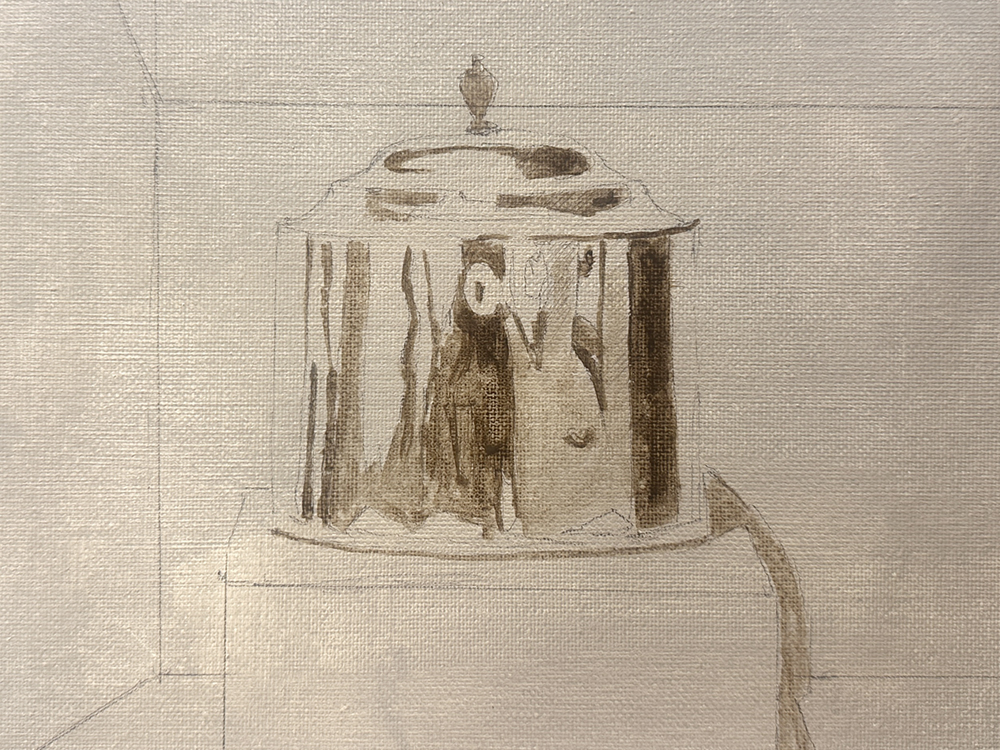
To begin the painting, I used Raw Umber diluted with water to block in some of the main dark areas.
I used a small round brush for this. Mine was a small Sceptre watercolour brush, but any small round brush would work well.
By changing the amount of water in the mix, you can make the Raw Umber lighter or darker. More water gives you a paler, more transparent wash. Less water gives you a stronger, darker mark.
The key thing with reflections is to stop thinking, “I’m painting silver,” and start thinking, “I’m painting abstract shapes inside the surface.”
Look at how the shapes relate to each other. Are they long and thin? Are they curved? Are they darker than the shape next to them?
That shift in thinking makes reflective objects much less intimidating.
Step 4: Build the Background with Raw Umber and White
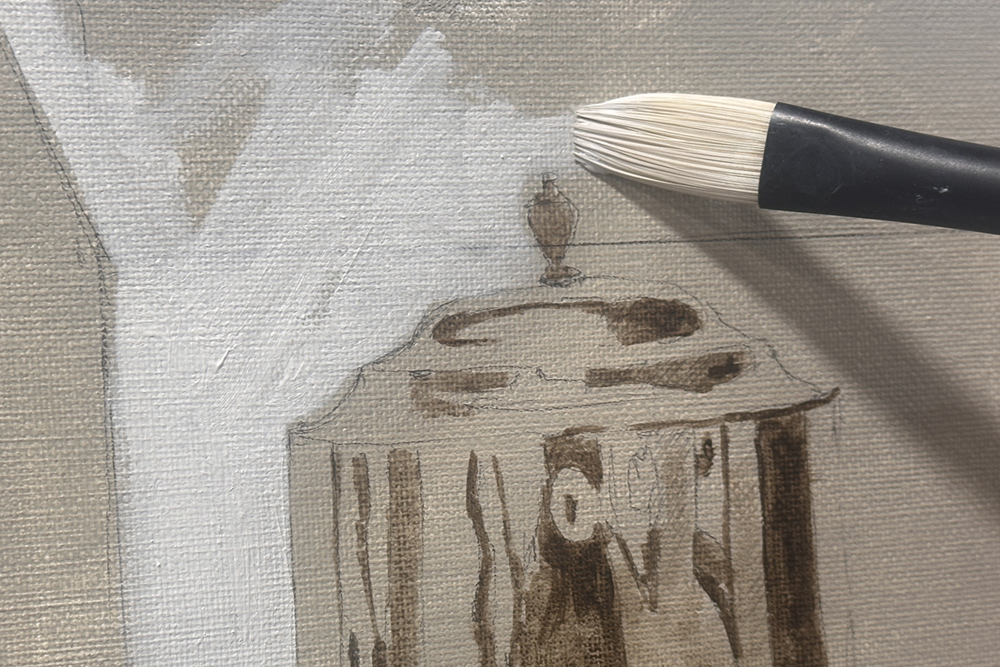
Once the first dark shapes were in, I mixed Raw Umber with Titanium White to create a range of soft neutral values for the background.
For this stage, I switched to a flat brush. I used a Princeton flat brush, but again, the exact brand isn’t important.
The advantage of using just Raw Umber and White is that you can move up and down the tonal scale very easily. Add more white to make a lighter value. Add more Raw Umber to make a darker value.
You don’t have to worry too much about hue shifts at this point. You’re simply concentrating on getting the values in the right place.
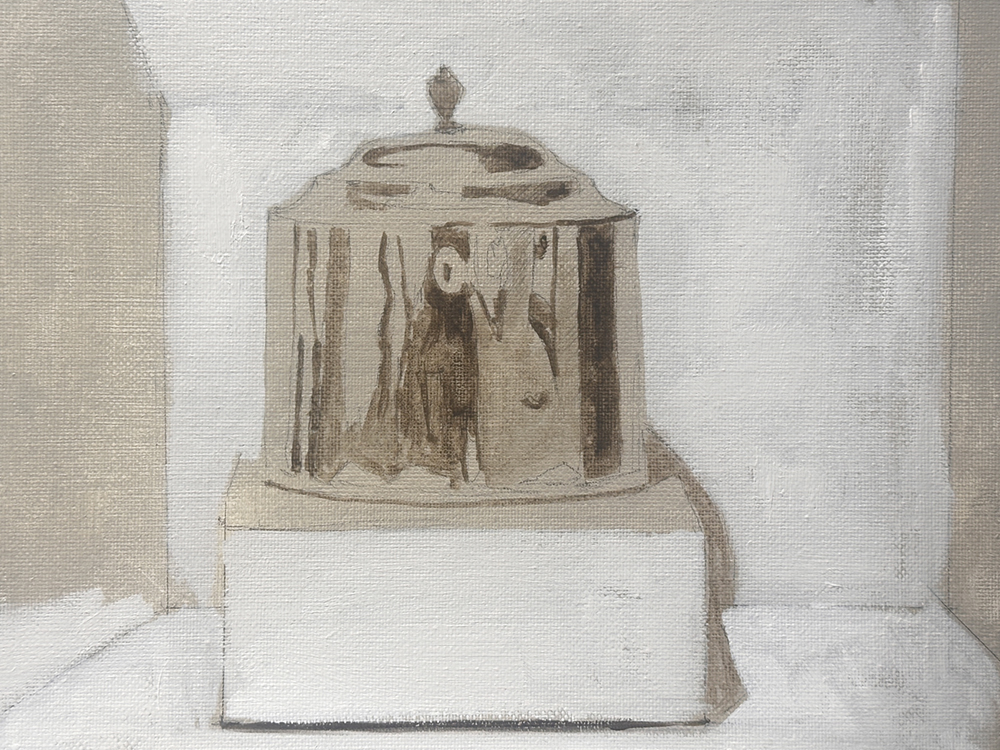
Some areas, especially on the right-hand side, were already quite close to the original ground colour, so I left parts of that showing where it worked.
Step 5: Take the Raw Umber and White as Far as You Can
Next, I carried the same Raw Umber and White mixtures into the tea caddy itself.
This is a really useful stage because it helps you see how much you can achieve with just one colour and white.
You might be surprised how many of the reflections can be suggested with only warm neutrals. The silver begins to appear not because you’re using “silver” paint, but because the values and shapes are starting to sit in the right relationship to each other.
Working this way also helps you notice which colours you can’t achieve with your current palette.
For example, as I worked across the tea caddy, I could see that an area on the right-hand side had a cooler, bluish tone. That was something I couldn’t mix from Raw Umber and White alone.
So rather than introducing lots of colours at once, I waited until I could clearly see what was missing.
Step 6: Introduce a Blue for the Cooler Reflections
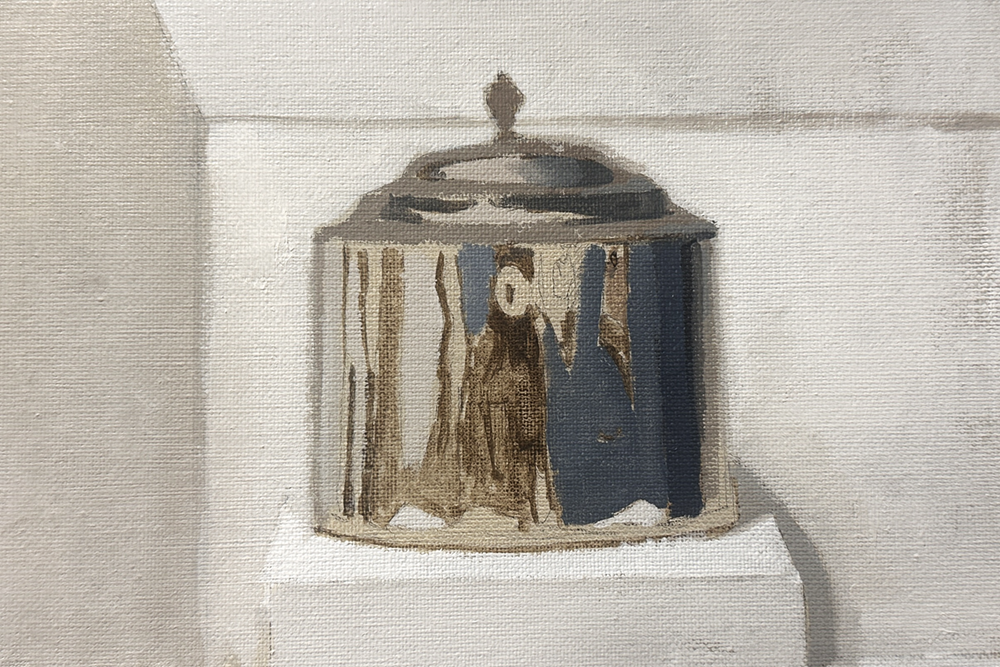
At this point, I introduced Prussian Blue.
Prussian Blue is quite a dark, strong blue, so you only need a small amount. It’s a little deeper and more intense than Ultramarine Blue.
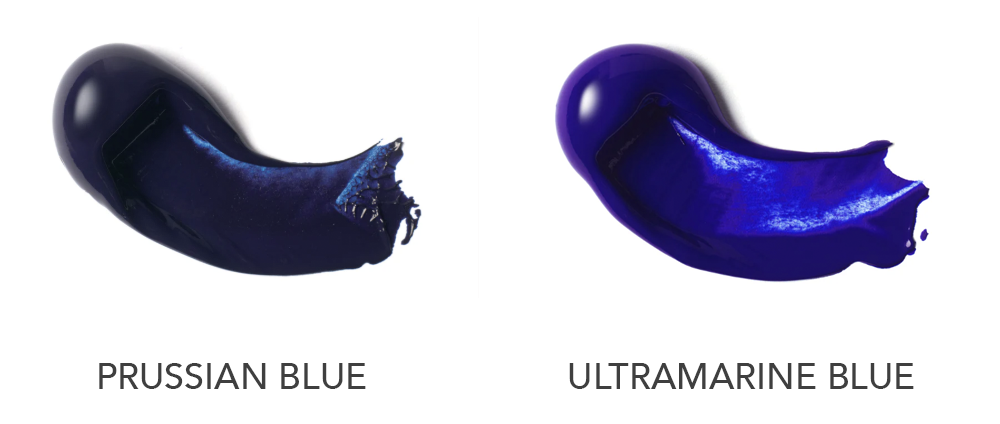
If you don’t have Prussian Blue, Ultramarine Blue would also work. If you’re using Ultramarine, I’d suggest adding Burnt Umber to the palette as well. A touch of Burnt Umber mixed into Ultramarine will knock back the intensity, giving you a more controlled, muted blue.
This is useful because the blue reflections in silver usually aren’t bright blue. They’re often cooler greys, blue-greys, or muted darks.
So the palette now becomes:
- Titanium White
- Raw Umber
- Prussian Blue
Or, if using Ultramarine:
- Titanium White
- Raw Umber
- Ultramarine Blue
- Burnt Umber
Step 7: Block in the Cooler Blue Areas
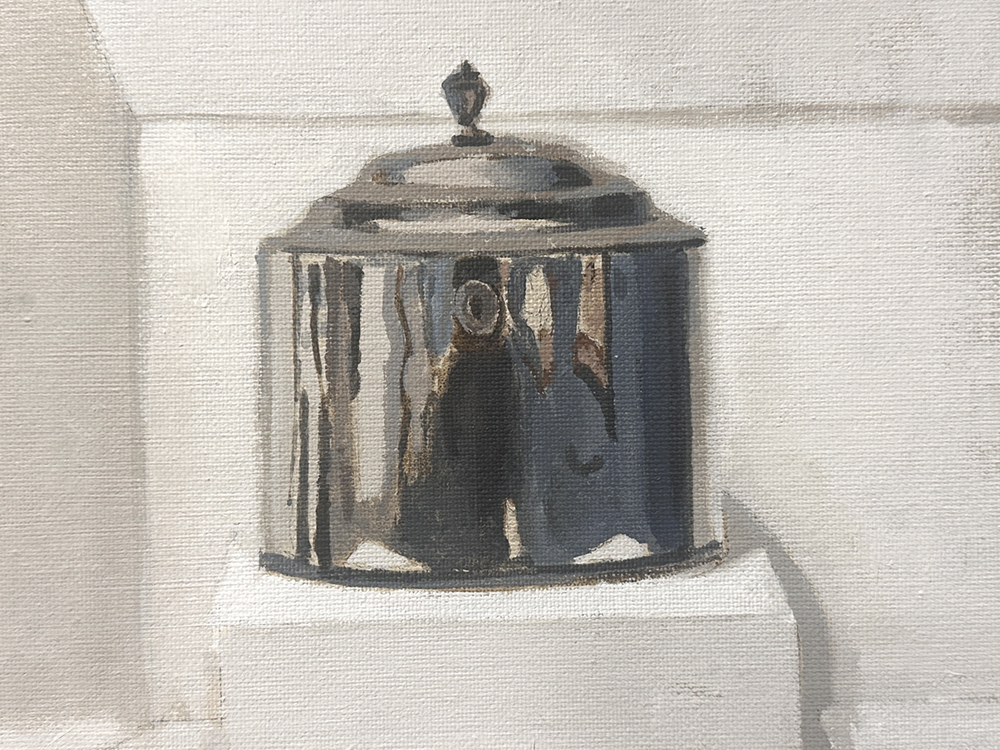
With the blue introduced, I started blocking in the cooler areas of the tea caddy.
Again, I’m still thinking in terms of abstract shapes. I’m looking at where the cooler notes appear and how they sit against the warmer Raw Umber and White mixtures. The goal is to cover the entire area so that none of the original ground colour shows through.
That’s important because even the tiniest bit of lighter ground peeking through can affect your judgement. It can make a dark area look lighter than it really is, or make a value relationship feel slightly off.
You’re asking:
How dark is this shape?
How light is the shape next to it?
Is it warm or cool?
Once those relationships are in place, the silver effect naturally emerges.
Once you’ve blocked in most of the blues and umbers, it’s worth taking another look at the reference image.
Step 7: Looking for other colours
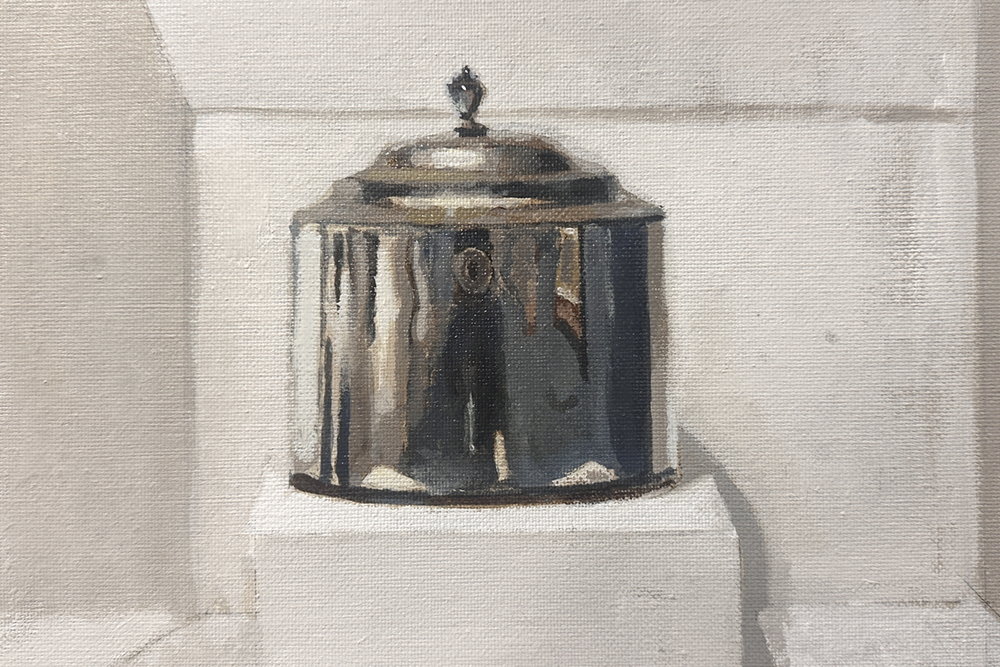
Once you’ve taken the warm and cool notes as far as you can, you’ll start to notice other subtle colour shifts. In some of the reflections, there’s a slightly yellow hue and a warmer colour, so I add a touch of Cadmium Yellow Medium here, but Yellow Ochre would also work well, as would Burnt Umber.
Add these warmer yellow notes sparingly, just in the areas where you can see them in the reference. The aim at this stage is to get the entire object blocked in, but without the brightest reflections yet.
Then comes the fun part: the highlights.
Step 8: Painting the Highlights
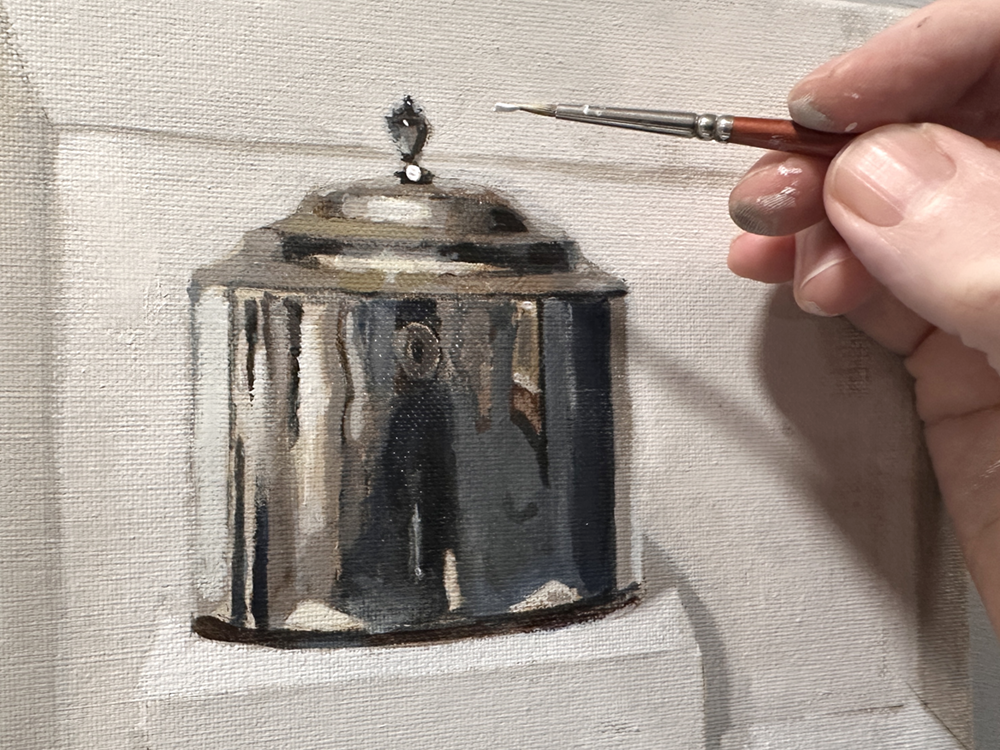
Using pure Titanium White, I’m going to paint the brightest reflections more thickly. These small, sharp marks are what suddenly help turn the surface from looking flat to looking reflective.
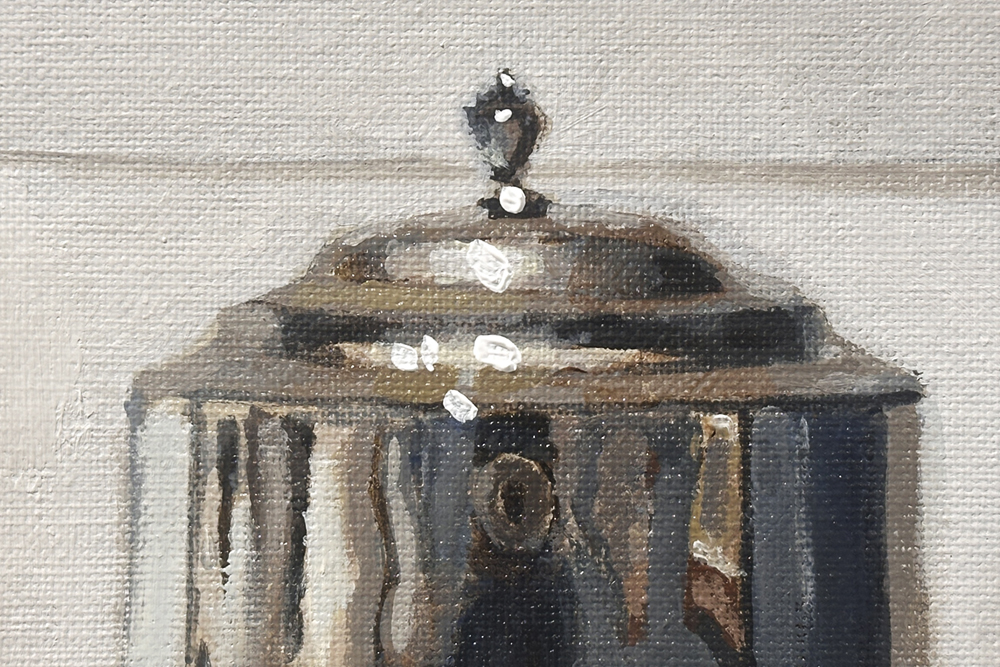
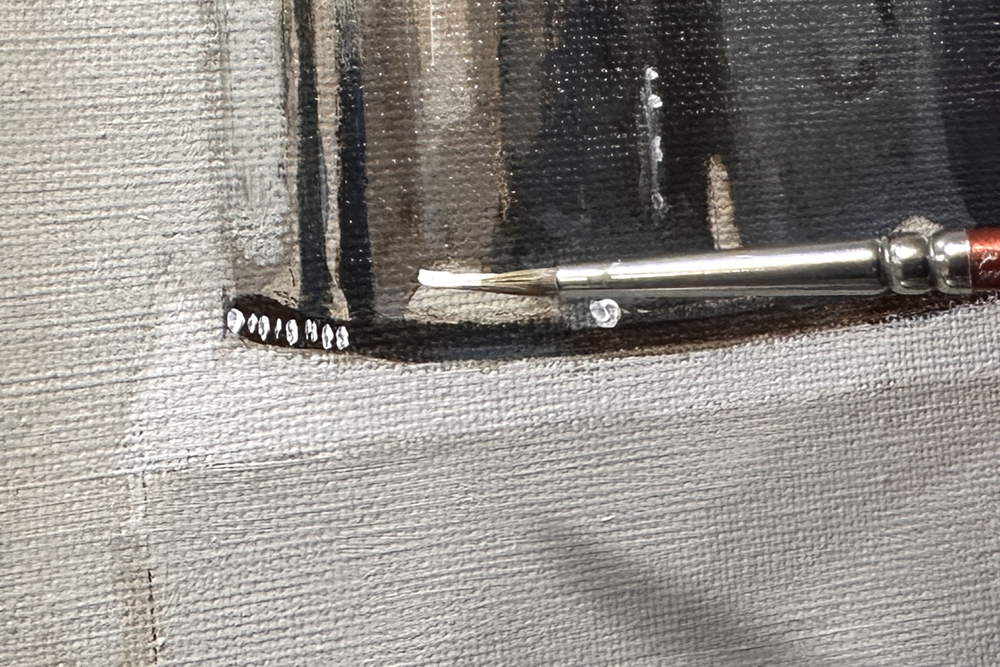
This particular silver caddy has a few bright reflections, but if I were setting up a subject like this at home, I’d angle the light to create more of those crisp, pinpoint highlights. They’re often the key to adding sparkle, contrast, and interest to a reflective silver object.
The finished painting
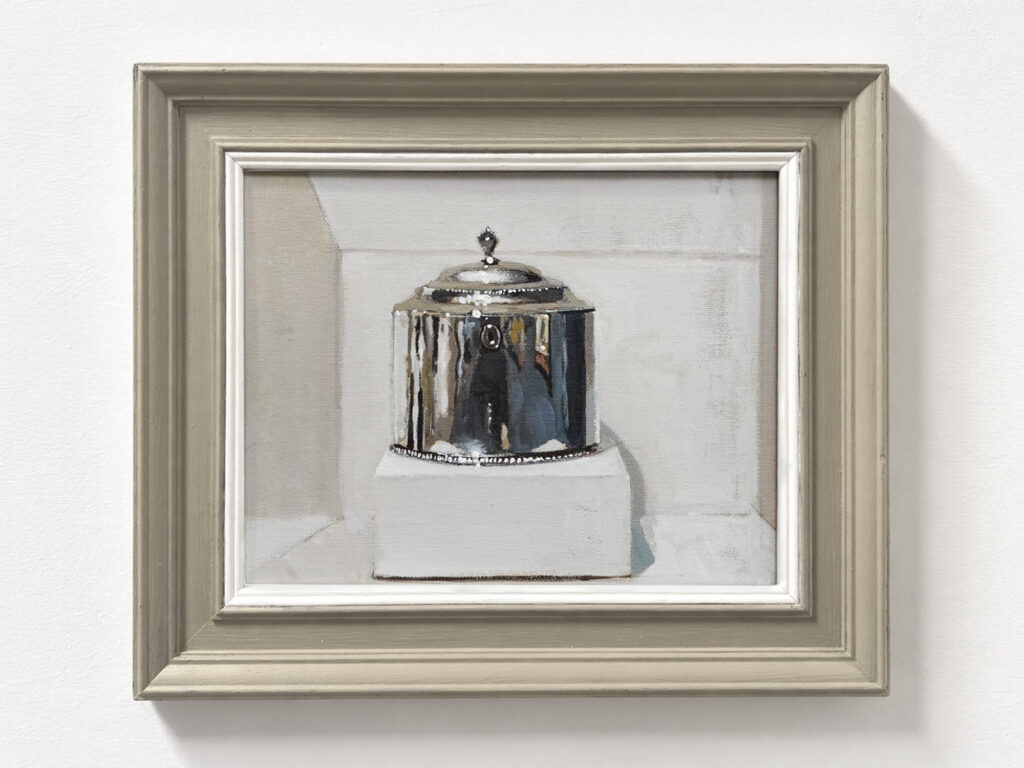
What would I do differently if I painted it again?
When looking at the reference gain, I’ve actually made things slightly more complicated for myself. Looking back at the caddy, the top and left-hand side are mostly warm, with a more Burnt umber tone. The right-hand side has more of a blue cast, but it still feels as though there’s a warm umber sitting underneath it.
So another approach would have been to block in the whole caddy first with Burnt Umber, to establish that underlying warmth, and then glaze or layer the cooler blue notes over the top.
Hope you enjoy giving it a go! You don’t need a special silver paint. You need accurate values, carefully observed shapes, and a few well-chosen temperature shifts between warm neutrals and cool blue-greys – and to go thick with that white paint!
Have a creative week ahead,
Will
You Might Also Like:
How to Paint Copper with Acrylics
How to Paint Reflective Glass with Acrylics
Still Life Masterclass Course – In this course, we paint a reflected silver hoblet, then move onto reflections in wood and ceramics